Side A · Liner notes
Analyzing the Decline of Labor Share Post-COVID: Trends and Insights
Banking · Words by Richard Johnson · Released
The U.S. labor share has hit historic lows post-COVID, indicating that economic growth is not benefiting workers as much as capital. This analysis explores the underlying trends and comparisons to previous recessions.
The labor share of income in the United States has reached its lowest point in the post-war period, an alarming trend that signals a growing disparity in how economic output is distributed. The labor share quantifies the percentage of economic output allocated to workers in the form of wages and salaries. A falling labor share typically means that while productivity and prices may be increasing, wages are not keeping pace. Following a long history of decline starting in the early 2000s, the labor share experienced a significant drop amid the COVID-19 pandemic. This article examines the current decline's nature in comparison with previous periods to determine if it represents a continuation of historical trends or signifies a distinct evolution in labor economics.
The Long-Term Trends of the Labor Share
The long-run evolution of the labor share has shown resilience over decades; it remained remarkably stable around 63 percent until the early 2000s. After entering a period of sustained decline, it plummeted during the global financial crisis. Numerous studies have delved into the factors contributing to this downward trend, which include technological advancements, the emergence of "superstar" firms, and increasing markups in markets.
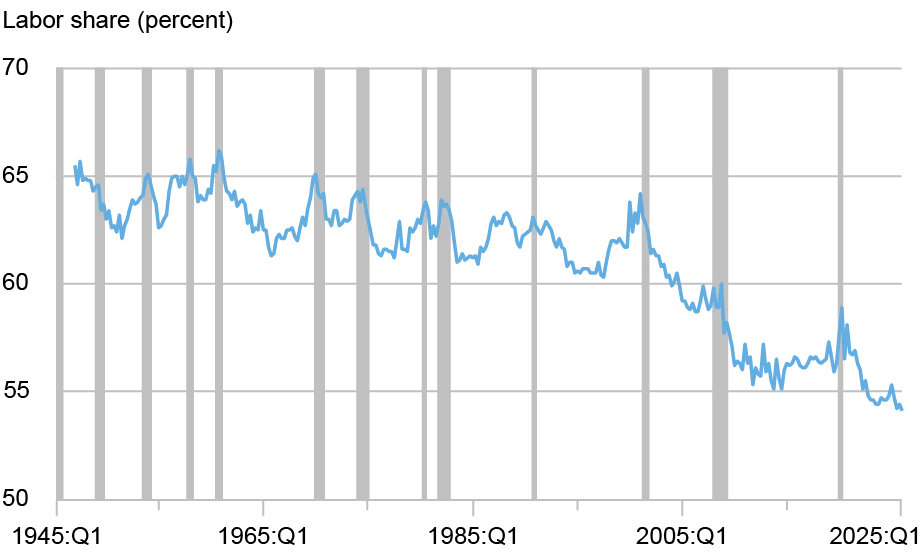
The most recent data shows the labor share's decline accelerating post-pandemic, ultimately falling 1.6 percentage points below pre-COVID levels. Currently, the labor share stands at an unprecedented low for the post-war period. This raises important questions about how the latest recession impacts labor share dynamics compared to historical downturns.
Comparing the Post-COVID Decline with Previous Recessionary Periods
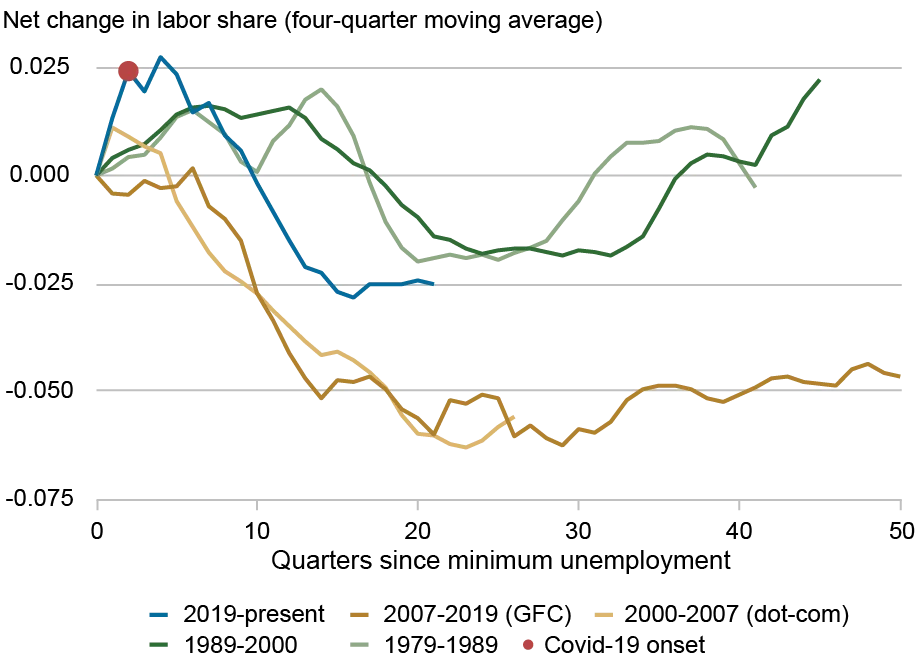
To assess the nature of the post-COVID labor share decrease, let's analyze its trajectory during previous recession-expansion cycles. A key observation is that previous recessions typically see the labor share rise during downturns, followed by declines through the recovery phase before rebounding in subsequent expansions.
However, the dynamics shifted significantly starting in the 2000s. During both the dot-com recession and the financial crisis, labor share declines in subsequent expansions were steeper relative to earlier cycles, and there was no meaningful recovery thereafter. Interestingly, the trajectory of labor share immediately following the COVID onset mimicked pre-2000 recession patterns: an initial sharp increase was followed by a slight decline, leading to a plateau. This suggests we may require an extended recovery phase before witnessing any potential labor share resurgence.
Sectoral Reallocation and Its Impact
One consideration regarding the labor share's decline is the economic shift across various sectors during and after the COVID pandemic. Certain industries, like healthcare and education, exhibit higher labor shares because they depend more on human expertise compared to sectors such as manufacturing, where machinery plays a larger role. If the relative output from lower labor share industries increased post-COVID, we would then expect a decrease in the overall labor share, independent of intra-industry labor share changes.

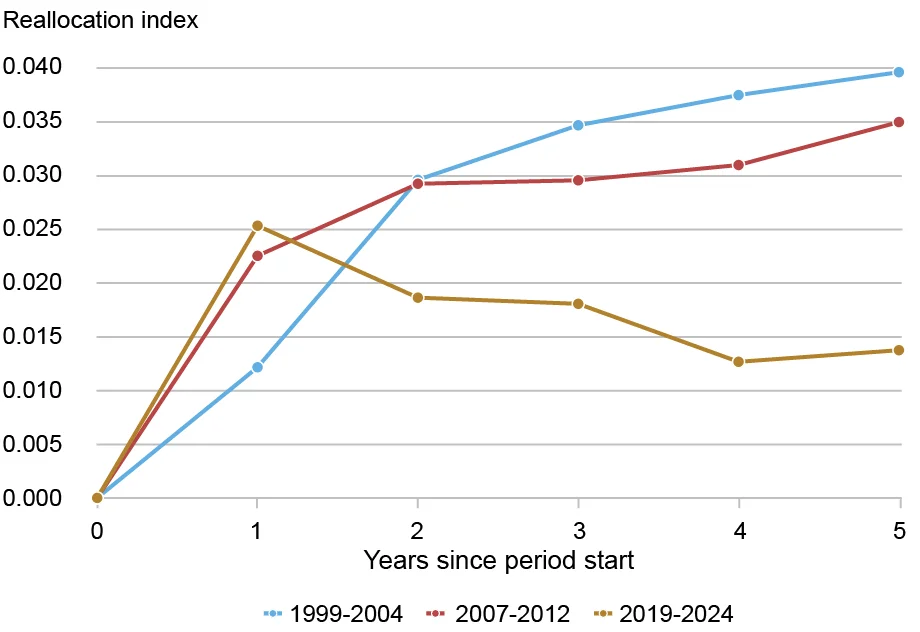
To understand whether the reallocation experienced due to COVID was uniquely impactful compared to prior economic downturns, we constructed a reallocation index. This index quantifies shifts in sectoral output shares. The analysis reveals that while there was a significant spike in economic reallocation at the COVID onset, it stabilized quickly at lower levels, contrasting with earlier recessions where reallocations remained persistent and amplifying.

Understanding the Shift-Share Decomposition
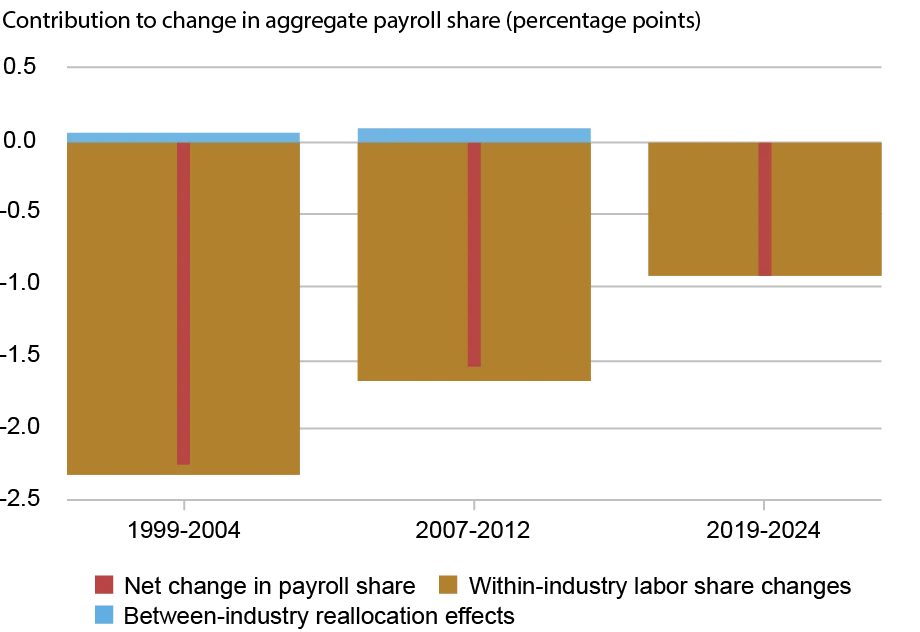
While evaluating sectoral reallocation's effects on labor share, we utilized a "shift-share" decomposition of payroll share. This approach allows us to disentangle changes resulting from intra-industry dynamics versus those driven by shifts in economic activity across industries. The findings indicate that the aggregate payroll share decline during the COVID period, similar to previous recessions, was entirely driven by within-industry changes rather than the reallocation effects across industries. This emphasizes that the fall in labor share is more about how industries pay their workers rather than broader economic shifts.

Conclusions and Future Considerations
This analysis highlights a persistent drop in labor share following the COVID pandemic. The evidence suggests that this decline appears to follow the cyclical patterns of prior U.S. recessions rather than signaling a transformative change in the labor market landscape. Both the trajectory of labor share after COVID aligns with historical trends and the decline principally results from intra-industry shifts. There's little indication that the current situation will diverge from past behaviors unless significant structural changes are implemented within individual sectors or the economy at large.

As labor economics continue to evolve amid shifting market conditions, capitalists and policymakers must consider the implications of labor share declines. Monitoring wage growth relative to productivity and sector performance will be crucial in assessing broader economic well-being and labor market health in the coming years.