Side A · Liner notes
Tariff-Induced Price Hikes Are Set to Continue for U.S. Businesses
Banking · Words by Joseph Jones · Released
Nearly half of U.S. companies paying tariffs plan to increase prices further, indicating ongoing inflationary pressures stemming from trade policy shifts.

This past year has marked significant changes in U.S. trade policy, with new tariff implementations and landmark judicial rulings redefining the economic landscape. As a result, many companies are grappling with a surge in costs, leading them to consider strategic decisions on whether to absorb these costs, raise prices, or use a blend of both strategies. Recent regional business surveys reveal that nearly half of the firms subject to tariffs anticipate additional price increases in the upcoming months.
Continued Price Increases Among Tariff-Paying Businesses
Tariffs, which are taxes levied on imported goods, inherently increase the cost base for domestic producers. Recent research highlights that approximately 90 percent of the economic burden of tariffs has fallen on U.S. firms and consumers. In fact, two-thirds of service-oriented businesses and nearly all manufacturers surveyed reported importing some of their production inputs. Of those importing firms, 40 percent of service firms and 70 percent of manufacturers stated they directly incurred tariffs over the past twelve months. These firms, along with many others affected indirectly via higher charges from suppliers, grappled with the challenge of price adjustments.
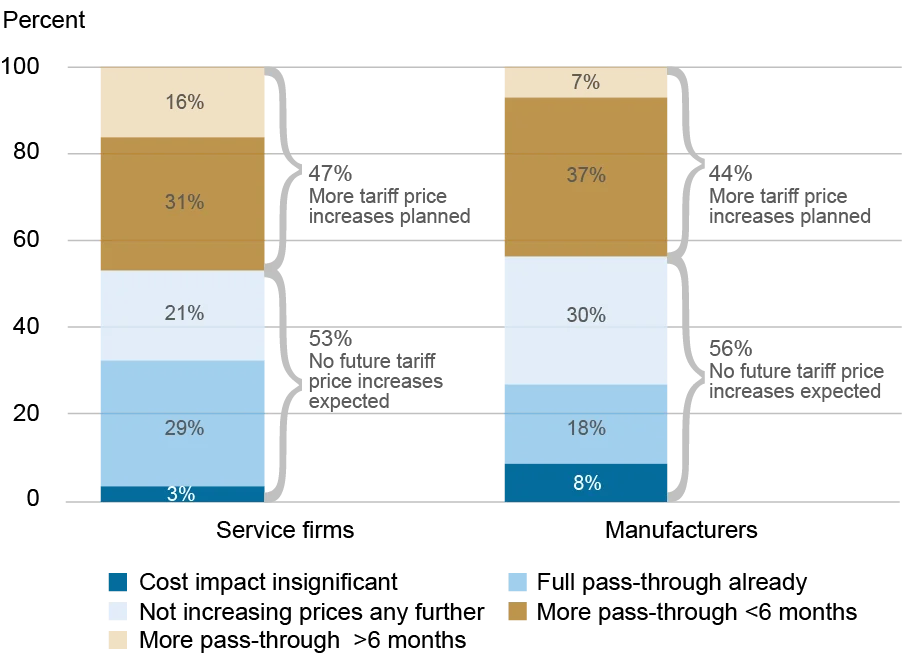
The accompanying chart illustrates the price adjustment behavior of firms that directly faced tariffs. A promising 30 percent of service providers and 20 percent of manufacturers noted they fully passed the tariff costs onto consumers. This suggests a portion of businesses has already adjusted their pricing strategy to account for tariff costs. However, an intriguing twist reveals that 47 percent of service firms and 44 percent of manufacturers with direct tariff expenses indicate they expect to institute further price hikes. Specifically, around 30 percent of tariff-afflicted service firms are projecting these increases within the next six months, while nearly 40 percent of manufacturers have similar expectations.

Reasons for Future Price Increases
The data suggests that a significant number of businesses have not completed their required price adjustments, more than a year post-tariff introduction. The reasons for ongoing price increases appear twofold. Firstly, businesses bound by long-term contracts cannot adjust their prices immediately, requiring them to absorb these rising costs until contract terms allow for revisions. Research confirms that such long-term agreements can obstruct the passing of increased costs through to consumers.

Secondly, some companies adopted a “trickle-up” pricing strategy. This cautious approach allows businesses to gradually raise prices instead of executing sharp increases, which could alienate customers. This incremental pricing strategy provides businesses the flexibility to spur faster price increases should input costs continue to climb. Furthermore, the uncertainty surrounding future tariff policies—including potential changes in rates, exemptions, or retaliatory measures from foreign countries—has driven firms to implement a measured pricing tactic, extending the timeline over which tariff-related costs are diffused through the economy.

The Persistence of Pricing Pressures
Economists and policymakers often expect that price hikes attributable to tariffs serve as a one-time adjustment; however, the context can indicate a much longer duration of inflationary expectations. Survey findings suggest that firms are increasingly spreading price adjustments across extended timeframes in response to a dynamic tariff landscape. This indicates that the inflationary pressures induced by tariffs may persist longer than initial assessments anticipated.

For instance, businesses are adapting their pricing strategies in response to shifts in input costs and the evolving trade environment, leading to a classic case of prices that reflect the changing nature of tariffs. These price increments are not isolated events, but rather represent a continuous response to an unpredictable trade policy climate that has significant implications for overall economic stability.

Looking forward, it becomes crucial for stakeholders—ranging from consumers to shareholders—to understand how these adjustments will continue to ripple through various sectors over time. As businesses adapt their pricing to offset tariffs, the reality of enduring inflation may necessitate more comprehensive responses by economic policymakers to prevent any exacerbation of price pressures influencing mainstream markets.
As not all firms are facing the same circumstances, the divergence in response highlights varying levels of impact across different sectors. The expectation is that the gradual nature of pricing changes will remain a topic for discussion amongst economists as they assess longer-term ramifications on consumer behavior and business strategies.
Overall, businesses appear set to continue passing on tariff-related costs, suggesting that consumers and other market participants will need to adjust their expectations to a reality that may be lasting despite calls for stabilization in the pricing landscape. The interplay between tariffs and price adjustments illustrates a complex matrix that requires ongoing attention from both businesses and policymakers alike.
Understanding the nuances of these developments will prove vital as companies navigate their operational adjustments in a landscape shaped by tariffs and resulting price inflation.