Side A · Liner notes
Nonbank Finance Within Bank Holding Companies: Exploring Regulatory Efficacy and Implications
Banking · Words by Joseph Johnson · Released
This article investigates the significant role of nonbank subsidiaries within Bank Holding Companies (BHCs) and how their structure presents opportunities for regulatory arbitrage.

In analyzing the intersections between bank regulation and the organizational frameworks of financial institutions, this article focuses on the substantial presence of nonbank operations within Bank Holding Companies (BHCs).

Nonbank Activities and BHCs: A Growing Share
Recent data reveals that nonbank subsidiaries constitute approximately 20 to 30 percent of the assets in consolidated BHCs since 2010. This translates to roughly one in four dollars of U.S. nonbank financial intermediation being managed by entities under the umbrella of a regulated bank. While the largest financial institutions dominate these statistics, a significant proportion of smaller BHCs—around two-thirds with assets between $1 billion and $10 billion—also maintain at least one nonbank subsidiary.
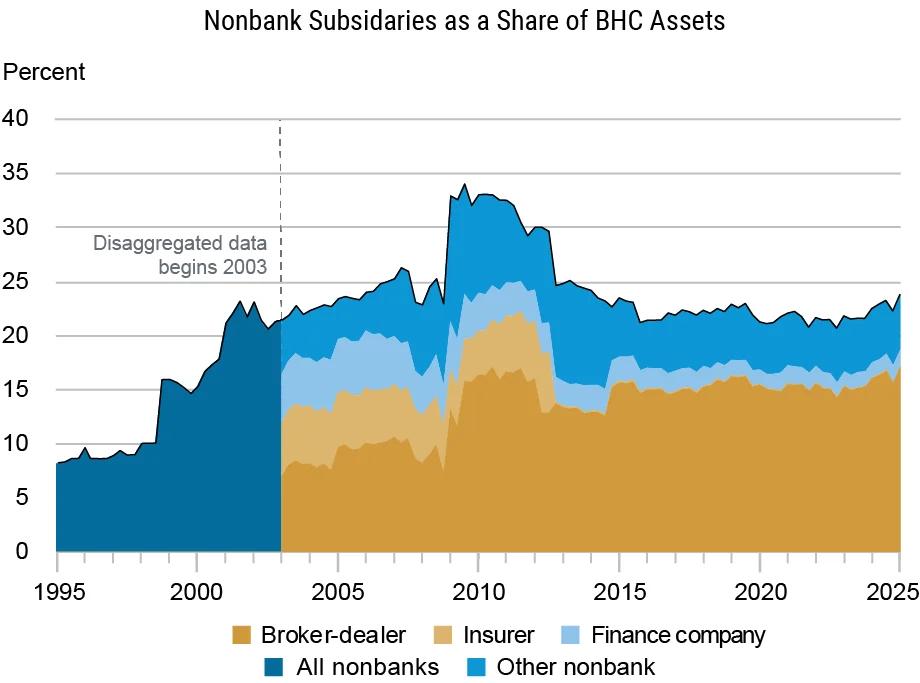
The interplay of bank and nonbank activities within these entities suggests a sophisticated organizational structure. Notably, a staggering 90 percent of nonbank subsidiaries are either wholly owned or majority-owned by their parent BHCs. This ownership grants parent companies significant control over capital allocation, financing strategies, and dividend policies across subsidiaries, thereby reinforcing the potential for regulatory challenges and opportunities.
Regulatory Capital Challenges for Nonbank Subsidiaries
An essential aspect of prudential regulation includes capital requirements that primarily target depository institutions and consolidated holding companies, while individual nonbank subsidiaries often face much lighter capital regulations. For instance, banks generally maintain common equity ratios reflecting specified minimums relative to their risk-weighted assets, whereas nonbank affiliates are subject to less stringent requirements.
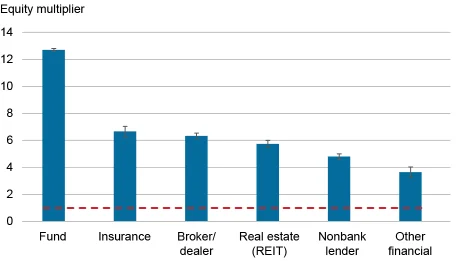
This disparity creates a complex landscape where capital within organizational frameworks is unevenly distributed. BHCs rely on borrowed funds, leveraging their access to insured deposits, which keeps their equity ratios low—typically around 10 percent of assets for median bank subsidiaries. Conversely, nonbank subsidiaries generally operate with high equity-to-asset ratios, averaging around 69 percent. The resultant “equity multiplier,” defined as the proportion of the entity's consolidated equity relative to its assets, illustrates that nonbank subsidiaries can account for as much as 16 percent of a BHC's consolidated equity while constituting only 2.5 percent of its consolidated assets, highlighting their role as crucial equity reservoirs.

Resource Reallocation within Bank Holding Companies
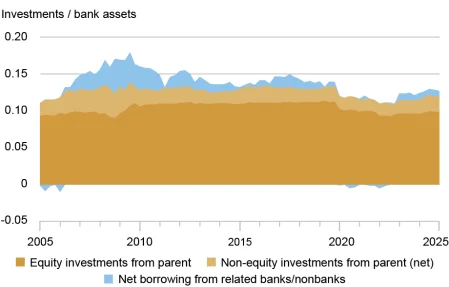
Understanding how capital moves within BHCs underscores the significance of nonbank subsidiaries. A growing body of research indicates that BHCs adeptly manage liquidity through internal capital markets, employing intra-firm loans and deposits to navigate financial pressures. Beyond liquidity, equity transfers represent an even more important mechanism of reallocation, with parent companies investing heavily in equity as compared to debt or non-equity investments.

Data indicates that parent equity investments in bank subsidiaries typically average between 10 and 11 percent of total bank assets, while non-equity positions hover around 1-2 percent. This imbalance in funding strategies indicates that when banks face tighter capital requirements, BHCs are more likely to adjust by reallocating equity rather than seeking external financing.

The Divergence Post 2015
The dynamics shifted noticeably in 2015, following the implementation of Basel III capital requirements. Pre-2015 trends showed both BHCs with and without nonbank exposure accumulating excess capital in parallel. Post-implementation, however, banks that are part of BHCs with nonbank subsidiaries accumulated capital significantly faster—creating an 8-10 percentage point gap in excess capital by 2020. Yet, at the consolidated BHC level, there wasn't a marked change in excess capital accumulation between firms with nonbank exposure and those without.

This indicates that capital enhancements for banks came primarily from internal equity reservoirs rather than external capital markets or increased investor support.
Implications for Stakeholders
The implications of this structural and regulatory interplay are vast. For shareholders, the relative advantage of BHCs with robust nonbank subsidiaries means potential for enhanced returns stemming from engaged equity management. Customers and employees may also benefit, as increased capital ratios can support more resilient banking operations. However, this arrangement introduces notable risks regarding transparency and systemic stability, particularly when regulatory scrutiny varies significantly based on the entity type.
As BHCs continue to evolve and adapt their capital structures, understanding these dynamics will be essential for all stakeholders involved—from finance professionals who analyze these entities to founders strategizing on organizational frameworks. Continued exploration and evaluation of these trends will be integral to ensuring an organized and impartial financial landscape.
In the subsequent parts of this series, we will delve deeper into these topics, including the consequences of the ongoing reallocation of capital within financial firms amidst changing economic conditions and regulatory expectations.
This exploration of the regulatory arbitrage inherent in nonbank subsidiaries operating within BHCs offers a lens into modern financial intermediation and compliance. Stakeholders across the financial spectrum must stay attuned to these developments, recognizing both the opportunities and challenges that accompany such structural complexities.


