Side A · Liner notes
How Basel III Influences Capital Movements in Bank Holding Companies
Banking · Words by Christopher Rodriguez · Released
Basel III's capital requirements prompt bank holding companies to shift equity from nonbank subsidiaries to meet regulatory standards, affecting their internal structuring.

Authors Nicola Cetorelli and Shohini Kundu outline how Basel III has altered capital management within U.S. bank holding companies (BHCs). This second post in a series highlights that when Basel III's capital requirements took effect in January 2015, BHCs faced two choices: raise external equity or tap into their internal reservoirs of equity-rich nonbank affiliates. The latter choice has become a prevalent response, allowing these organizations to meet regulatory standards without incurring the costs of new capital raises.

Capital Dynamics of Bank Holding Companies
In the wake of tighter capital requirements, BHCs have shown a distinct trend: while their bank-level capital has increased, consolidated capital across these holding companies has remained stable. Historical data and analysis reveal a significant difference in organizational complexity based on regional deregulation patterns in interstate banking. States deregulated their banking sectors during different periods from the 1970s to the early 1990s, creating disparities in how BHCs operated. Those headquartered in states that deregulated earlier developed more complex corporate structures, enabling them to allocate capital differently once Basel III came into effect.
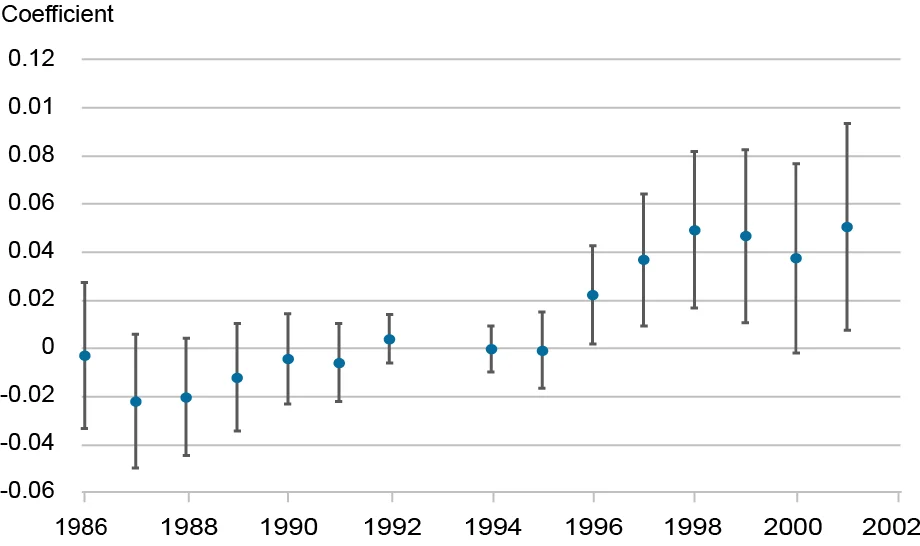
Research indicates that BHCs in states with early deregulation accumulate about 5 percentage points more excess capital at the bank level after 2015, contrasting sharply with zero excess capital increase at the consolidated level. This scenario suggests that BHCs are creatively utilizing existing internal capital rather than relying on external financing.

Internal Capital Reallocation: A Three-Step Process
The reallocation of equity occurs in a systematic three-step process within BHCs equipped with significant nonbank operations:
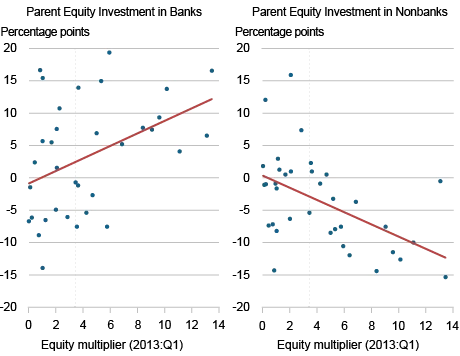
- Step 1: Shifting Equity: The parent company reallocates equity towards banks, reflected in a 2.28 percentage point increase in bank equity investments per year of deregulation exposure, while investments in nonbank subsidiaries decline by nearly the same magnitude.
- Step 2: Nonbanks as Cash Sources: Nonbank subsidiaries increase dividend payouts to the parent company significantly, with dividends from bank subsidiaries remaining relatively stable. This allows BHCs to draw resources from less-regulated nonbank entities to bolster their banks.
- Step 3: Retaining Earnings at Banks: Following Basel III implementation, banks within these BHCs have opted to retain more of their earnings instead of distributing them to the parent company, contributing further to a buildup in bank capital.
Together, these mechanisms illustrate a well-orchestrated internal rearrangement of resources, effectively increasing bank capital while leaving consolidated organizational capital unchanged.

The Significance of Equity Reservoirs
Within bank holding companies, nonbank subsidiaries serve as "equity reservoirs," possessing a higher share of organizational equity relative to their assets. This concept is quantified through the equity multiplier, indicating how much nonbank equity can be drawn upon. Our findings confirm that the response to Basel III correlates with the size of these equity reservoirs. BHCs with more substantial equity reservoirs increase their investments in banks by larger margins post-2015.

The analytical data show that as the equity multiplier increases, so too does the tendency of BHCs to allocate more of their equity towards bank subsidiaries at the expense of nonbank subsidiaries. Specifically, for every unit increase in the equity multiplier, there is a corresponding increase of 1.71 percentage points in the portion of consolidated equity dedicated to banks.

Risk Reassessment in Capital Allocation
One key takeaway from the analysis is that while BHCs have essentially maintained their aggregate risk level—indicated by stable returns on assets and equity post-Basel III—they have restructured where risk lies within their organizations. By internally reallocating capital from nonbank affiliates to banks, BHCs reinforce their banking side at the potential risk of increasing exposure for the nonbank subsidiaries.

The forthcoming post in this series will delve deeper into the consequences of this capital reallocation, particularly focusing on how the nonbank subsidiaries, which fuel this internal capital market, might bear the brunt of increased risks associated with this strategic shift.
As these dynamics unfold, observers from various sectors including investors, financial analysts, and regulatory bodies should monitor how this internal capital management approach impacts not only the profitability of BHCs but also the vulnerabilities introduced to nonbank affiliates. Such developments could have broader implications for the financial system, particularly in how intertwined banking and nonbanking operations can lead to systemic risks.
In essence, the analysis underscores the complexity of BHCs' responses to regulatory pressures and emphasizes the need to comprehensively understand the underlying financial architecture to gauge potential risks and stability in the banking sector.
Ultimately, while BHCs might achieve capital adequacy through clever arrangements of their equity, the persistence of systemic interconnections raises questions about the sustainability of this strategy in the long run.
How to cite this post:
Nicola Cetorelli and Shohini Kundu, “How Basel III Changes Where Capital Sits: Nonbank Subsidiaries as Equity Reservoirs,” Federal Reserve Bank of New York Liberty Street Economics, July 16, 2026, https://doi.org/10.59576/lse.20260716


