Side A · Liner notes
Exploring the Impact of Capital Reallocation on Nonbank Subsidiaries within Bank Holding Companies
Banking · Words by Christopher Jones · Released
This article examines how the reallocation of capital in bank holding companies, particularly from nonbank subsidiaries, impacts financial stability and risk management.

Introduction to Capital Reallocation in Bank Holding Companies
The interaction of bank regulation and the organizational structure of banking firms has become a focal point for understanding financial stability. In a three-part series, researchers Nicola Cetorelli and Shohini Kundu explored how bank holding companies (BHCs) have managed capital in light of Basel III regulations. The findings reveal that while banks themselves have become safer, the measures taken to achieve this may have inadvertently transferred risks to less visible nonbank subsidiaries.

The Transformation of Banks Post-Basel III
After the implementation of Basel III, banks generally saw improvements across key metrics. Capital ratios increased and charge-offs decreased, leading to an overall enhancement in asset quality. Notably, banks mitigated concerns that higher capital requirements would result in riskier behavior. Instead, they reduced risk-weighted assets relative to total assets, favoring securities and cash over risk-laden investments. This strategic shift resulted in stronger balance sheets, suggesting that the immediate objectives of Basel III were met effectively, with decreased leverage and no adverse effect on returns from new equity.
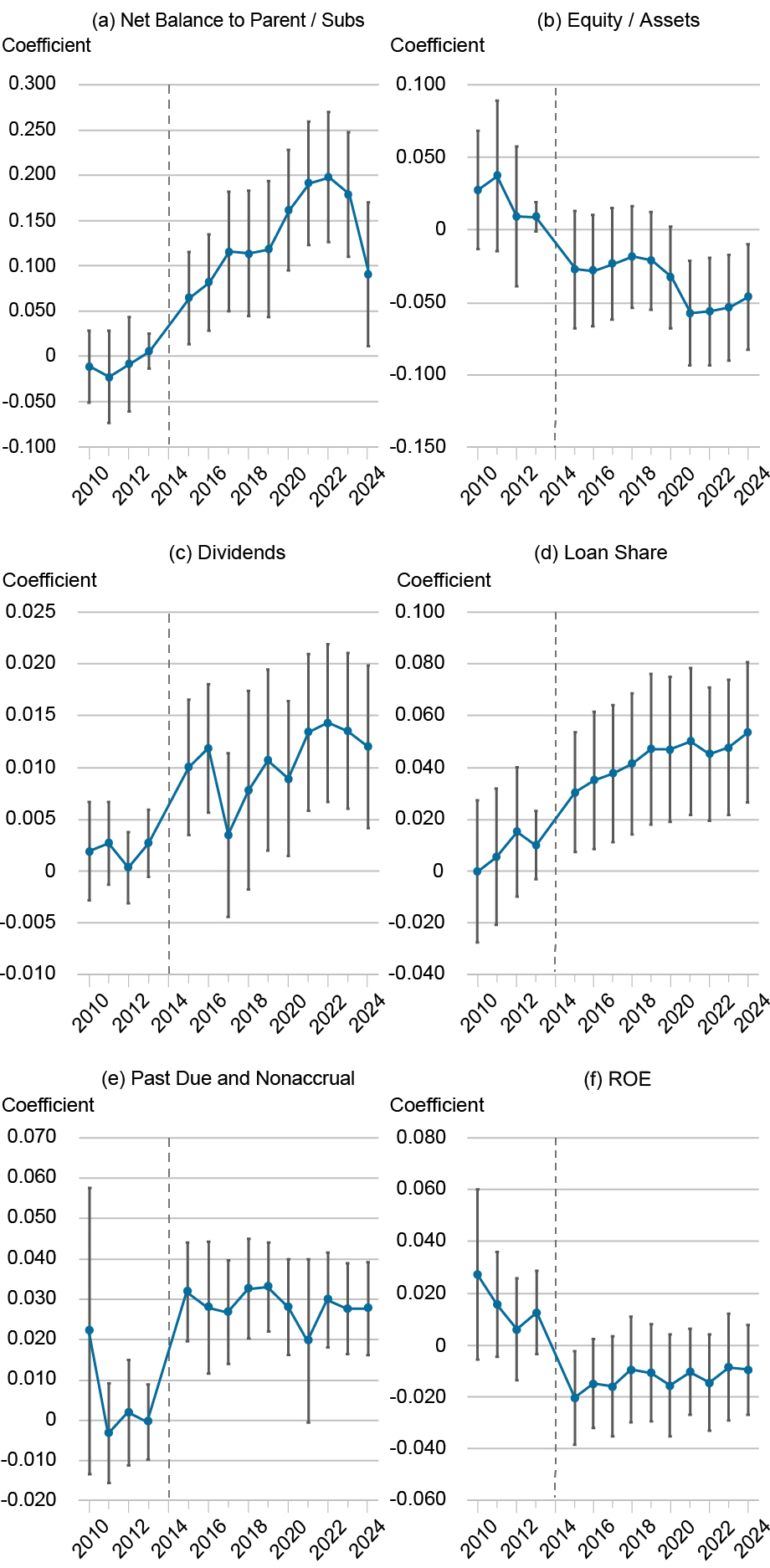
Shifts in Nonbank Subsidiaries
Contrastingly, nonbank affiliates exhibited troubling trends following the onset of Basel III restrictions in early 2015. Event study data illustrates a clear downturn for these subsidiaries, as their equity-to-asset ratios decreased while dividends to BHC parents increased. The observed behavior indicates a significant shift from traditional, equity-intensive business models to more leveraged lending practices, particularly in consumer credit. As a result, nonbanks retreated from more stable activities like trading and advisory services, thereby increasing their exposure to riskier, less regulated lending.

Fragility and Internal Capital Markets
This migration of risk from banks to nonbank entities poses significant concerns about the overall stability of BHCs. Despite the nonbanks being viewed as separate entities, market perceptions attach implicit support expectations to them. This means that in times of financial distress, nonbank failures could lead to systemic consequences affecting the parent bank due to the inherent interdependencies between the holding company and its nonbank subsidiaries. The immediate implications can be severe, as rating agencies often assign higher credit ratings to broker-dealer subsidiaries based on the presumed backing of their parent companies.

Stress Testing Nonbank Exposures
To better understand the potential impacts of these fragilities, stress tests were conducted, simulating losses between 1% to 15% of nonbank assets. The results indicate that, on average, BHCs may need to deploy about 18% of their excess capital to support their nonbank affiliates following a loss of 5% in nonbank assets. In more extreme scenarios, up to 100% of the available excess capital could be required, with a significant number of organizations facing exhaustion of their capital buffers. Such outcomes suggest that the supposed safety gained from capital transfers may not translate into real stability across the entire organization.

The Financial Implications of Support Structures
When evaluating the overall gains from capital reallocation, the support costs for nonbank affiliates must be considered. For most BHCs, the capital gain persists across various support levels; however, the impact varies significantly among organizations exposed to higher risks. In extreme cases, where institutions are required to offer support to their nonbank arms, the total cost may compromise over 70% of their capital gain, rendering the transfer counterproductive and exacerbating the overall financial health of the institution.

Regulatory Insights and Future Considerations
The findings from this analysis emphasize the need to reconsider regulatory frameworks and organizational structures within the banking sector. While Basel III's capital requirements succeeded in fortifying banks on an individual basis, they inadvertently triggered a reallocation of risk that potentially undermined financial stability at the collective level. This highlights a crucial aspect of regulatory design: the uneven application of capital requirements across subsidiaries allows risks to remain embedded within the same organization, rather than being mitigated entirely.
Implications for Financial Regulation
The study's conclusion urges regulators to look beyond traditional models of bank safety and to consider the broader implications of capital distribution within corporate structures. Understanding the interconnectedness of banks and their nonbank affiliates is vital for assessing systemic risk. Moreover, with the migration of activities from regulated banks to less-regulated nonbank entities, monitoring the stability and health of these subsidiaries becomes more critical. In essence, the lessons drawn from analyzing the reallocation of capital within BHCs stress the need for comprehensive regulatory frameworks that account for the complexities inherent in modern financial organizations.
As financial systems evolve, the interplay between capital regulation, organizational structure, and risk exposure will continue to shape the landscape of banking stability. Addressing these challenges effectively will be vital for ensuring the resilience of financial institutions in the face of future economic uncertainties.
For stakeholders, including shareholders and regulators, the implications of these findings warrant careful attention as they navigate the shifting dynamics of capital allocation and risk management.


