Side A · Liner notes
Understanding the Dynamics of Repo Markets: Key Borrowers and Lenders
Markets · Words by Gara Afonso, Jun-Davinci Choi, Gonzalo Cisternas, and Will Riordan · Released
Repo markets play a crucial role in the financial system, with hedge funds as primary borrowers and money market funds as key lenders, reflecting significant trends.

In the U.S. financial system, the repo market—short for repurchase agreement—serves as a critical mechanism for facilitating liquidity among financial institutions. This article provides an in-depth look at the participants in repo markets, exploring major players and their motivations, alongside the structural dynamics that underscore the significance of repos in the broader financial landscape.

What are Repos?
A repurchase agreement, or repo, involves a transaction where one party sells a security to another in exchange for cash, with a commitment to buy back the same security at a predetermined price by a specified date. When viewed from the perspective of the buyer, this transaction is termed a reverse repo. Repos are essential for funding and short-term investment by financial institutions, as they not only serve as a source of liquidity but also create a marketplace for specific securities. Current estimates suggest that the daily volume of outstanding repos in the U.S. is around $13.5 trillion, representing approximately 40 percent of the nation’s GDP (OFR 2026).
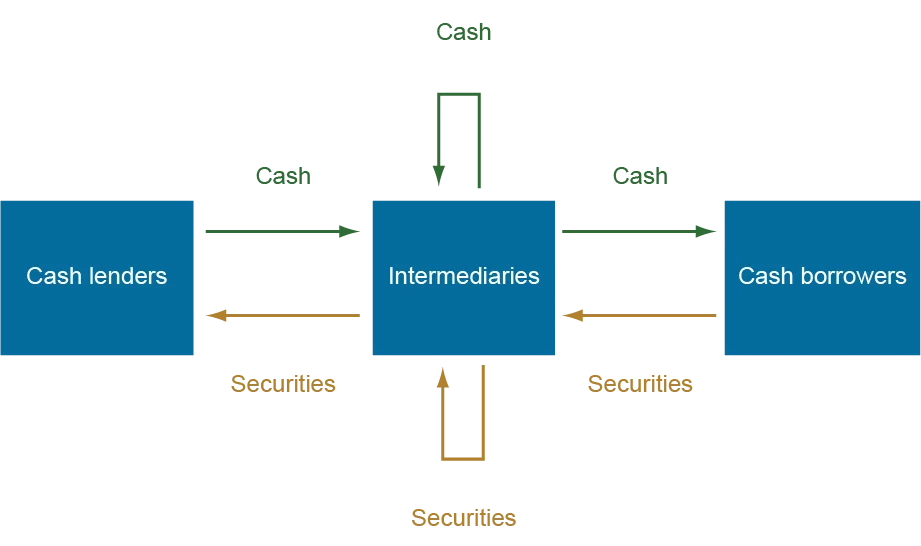
The rate at which these repos are executed, known as the repo rate, is influenced by several factors: the type of collateral (securities sold), maturity length of the agreements, counterparties involved, the size of the haircut (the difference between the value of securities and cash delivered), and the clearing method used. Most repos are collateralized by U.S. Treasury securities, often with overnight maturities. Approximately 70 percent of repos involve collateral from Treasury securities, with over half cleared through either a central counterparty or third party, while 40 percent are cleared directly between buyers and sellers (OFR 2025).
Historical Context of Repo Markets
The development of repo markets dates back to the early 20th century, but their size and operational norms shifted significantly during the 1980s. This change was largely a response to the bankruptcy of several dealers, amidst rising interest rates and an increasing supply of Treasury debt (Garbade 2006). Key conventions—such as the exemption of repos involving Treasury and federal agency securities from the automatic stay rule in U.S. Bankruptcy Code—have enhanced the liquidity of these markets. This exemption allows cash lenders greater security in repo transactions, enabling them to swiftly terminate contracts and liquidate securities if a borrower defaults, thereby bypassing the unpredictability of bankruptcy proceedings.

Uses of Repos
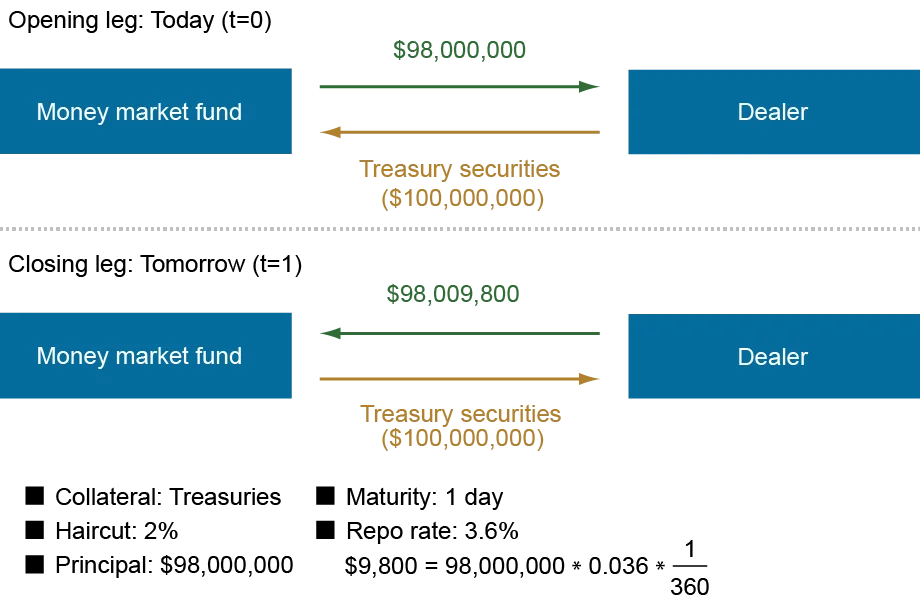
Engaging in repo transactions allows borrowers to obtain cash effectively while cash lenders can invest for returns or secure specific securities. Notably, general collateral repos (GC repos) exemplify transactions where cash lenders are not concerned about the precise securities received. Instead, in a GC repo, the cash lender accepts any security meeting predefined criteria, making it a competitive funding avenue for cash borrowers looking to finance a range of securities.

For instance, a money market fund (MMF) may lend to a repo dealer against a selection of Treasury securities with a haircut of 2 percent, illustrating the funding dynamics at play. The subsequent day, the MMF receives a greater amount based on the agreed terms, demonstrating the effective yield benefits associated with these transactions.

Who Participates in Repo Markets?
The private repo landscape exhibits more complexity compared to other financial markets, such as the federal funds market, due to a wider array of participants. One of the most significant categories in this market includes cash borrowers, with hedge funds leading the way. These funds often leverage repos to amplify returns on investments, exemplified by the "Treasury cash-futures basis trade," which involves purchasing a Treasury security and concurrently selling a futures contract to profit from price discrepancies. Hedge fund borrowing in repo markets surged from $400 billion in 2013 to $3 trillion by late 2025, reflecting a substantial increase in engagement.

Other notable borrowers in repo markets include U.S. branches and agencies of foreign banks (FBOs), U.S. depository institutions (USDIs), and real estate investment trusts (REITs). Over the last decade, their borrowing has fluctuated between $800 billion and $1.3 trillion, indicating robust participation across different borrower types.

The Role of Lenders in Repo Markets
On the lending side, money market funds dominate the landscape, exhibiting a dramatic growth trajectory in lending activities. From approximately $600 billion in January 2013, MMF lending nearly tripled to $3 trillion by January 2026, showcasing their appeal for short-term investments that comply with regulatory standards while simultaneously providing liquidity for managing investor redemptions.
Additionally, while hedge funds primarily act as borrowers, they also lend capital, engaging in the repo market to manage liquidity and transform collateral. By late 2025, hedge funds had increased their lending volume to around $1.3 trillion, a notable rise from $350 billion in early 2013. Other lenders such as government-sponsored enterprises (GSEs), U.S. branches and agencies of foreign banks, and U.S. depository institutions have also contributed significantly, with lending amounts in the range of $0.6-$1.5 trillion throughout the 2013-2025 period.

Conclusion
Repo markets serve as an integral framework enabling financial entities to engage in secured, short-term lending and borrowing. The motivations of participants—whether they're seeking cash, returns on investments, or specific securities—demonstrate the multifaceted nature of this market, which operates in trillions of dollars. The complexity and dynamics of the repo sector set the stage for further exploration regarding the microstructural aspects of various market segments, as well as its broader implications for monetary policy.


