Side A · Liner notes
Understanding the Impact of Tariffs on Consumer Prices: Key Findings and Implications
Banking · Words by Mary Amiti, Sebastian Heise, and David E. Weinstein · Released
Research shows that a 1% increase in tariffs results in a 0.25% rise in consumer prices, with direct and indirect effects playing distinct roles.

Recent research by Mary Amiti, Sebastian Heise, and David E. Weinstein offers critical insights into how tariffs influence consumer prices, particularly focusing on the tariffs established in 2025-2026. Their findings indicate that a one-percentage-point increase in average tariffs correlates with a 0.25% rise in the prices of consumer goods within a year, illustrating the significant impact of policy decisions on economic outcomes.

Direct Impact of Tariffs on Import Prices
When a tariff is applied, the immediate effect is an increase in the price that U.S. importers, be they firms or consumers, pay for foreign goods. The research reveals that foreign exporters typically absorb minimal costs from tariffs, resulting in nearly 90% of the tariffs being reflected in U.S. import prices. This relationship remains consistent even when accounting for fluctuations in exchange rates, which have also contributed to rising import prices. Specifically, in the first month after a tariff is imposed, prices for imports nearly match the tariff increase, indicating a strong one-to-one pass-through effect.

Indirect Effects on Domestic Producer Prices
Tariffs exert not only a direct influence but also an indirect impact on domestic prices. Many domestic producers rely on imported materials and parts; thus, tariffs escalate their production costs. For instance, an increase in steel tariffs makes U.S. automotive manufacturing more expensive. This situation exemplifies the marginal cost channel. The second way tariffs induce indirect effects is through competitive pressure: as imports become pricier, U.S. producers feel less urgency to keep their own prices low. This phenomenon is referred to as the strategic complementarity channel. The research suggests that U.S. manufacturers do raise their prices due to these influences, with the marginal cost effect being the more significant of the two. However, the response in domestic producer prices unfolds more gradually compared to the immediate increase in import prices; initial adjustments are modest and typically grow over the next six to twelve months.

Translating Producer and Import Prices to Retail Prices
The passage of changes in import and producer prices to retail prices reflects the structure of distribution costs, which account for approximately half of what consumers ultimately pay. The analysis estimates that a 10% uptick in import and domestic producer prices due to tariffs results in about a 5.6% rise in retail consumer prices. For example, if a product sells for $100, where $50 corresponds to the cost at the import or factory level, a tariff-induced increase in producer price from $50 to $55 would elevate the retail price to $105—demonstrating a clear link between producer prices and what consumers pay at the store.

Aggregate Consumer Price Increases from Tariffs
The collective effect of direct and indirect tariff impacts can be illustrated by simulating a scenario where a 10% tariff is applied universally to imports. In this case, consumer goods prices are projected to rise by 2.6% after one year—effectively translating to about a quarter of the tariff increase. A substantial portion of this rise, about two-thirds, originates from the direct increase in import prices, while the rest stems from the indirect rise in prices of domestically produced goods, largely due to the marginal cost channel. This price adjustment is not instantaneous; the immediate effects of higher import prices manifest quickly, with about half reflected after three months and full adjustment typically taking up to six months. Conversely, the indirect impacts from domestic prices may take longer to materialize, with significant adjustments occurring between six and twelve months post-tariff imposition.

Evaluating the 2025-26 Tariffs and Subsequent Goods Price Inflation
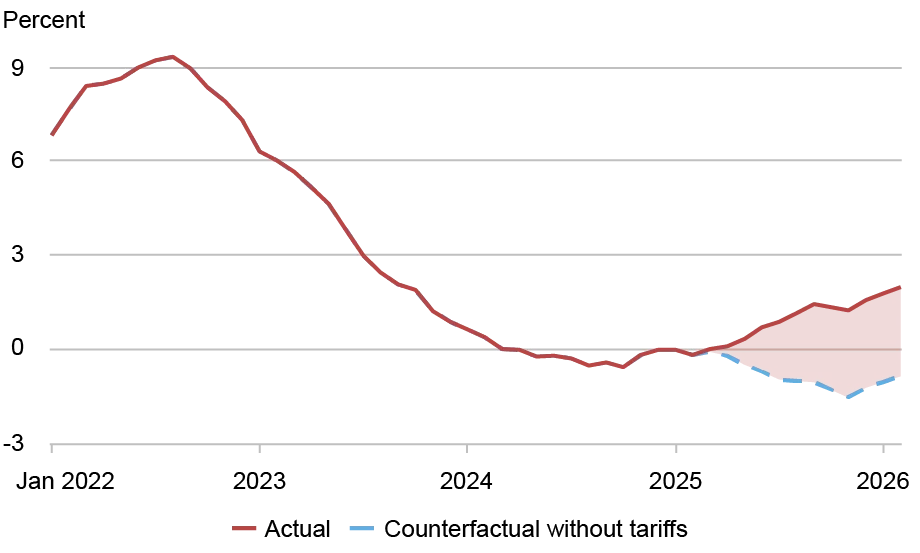
The investigation extends to examining price shifts across consumer goods, distinguishing between those with higher and lower tariff exposure. The research utilized data from the U.S. Bureau of Labor Statistics, focusing on non-oil categories while holding broader economic factors constant. In this analysis, it became evident that the consumer goods price inflation was returning to its pre-COVID levels by early 2024 but began to rise again with the introduction of new tariffs. By February 2026, tariffs had contributed approximately 2.9 percentage points to the overall goods price inflation that would not have occurred if the tariffs hadn’t been imposed. Without these tariffs, inflation in goods prices would have been negative.
Tariffs Raised Consumer Goods Price Inflation
Forecasting Future Tariff Impacts on Consumer Prices
The authors extend their analysis to forecast potential price impacts through September 2027, assuming that the tariffs will remain at their late-September 2026 levels with some exceptions. In their projections, the estimated effect of imposed tariffs on consumer goods prices peaks around 3% in February 2026, primarily driven by the immediate channel of direct price increases. By August 2026, this effect is expected to decrease to about 2%, influenced largely by a Supreme Court ruling that modified earlier tariffs. The indirect effect from increased U.S. producer prices remains in play and adjusts slower, hence the long-term influence of tariffs persists even as the inflationary effects dissipate in the short term.
Tariff Effects on Consumer Goods Prices Peaked in February 2026
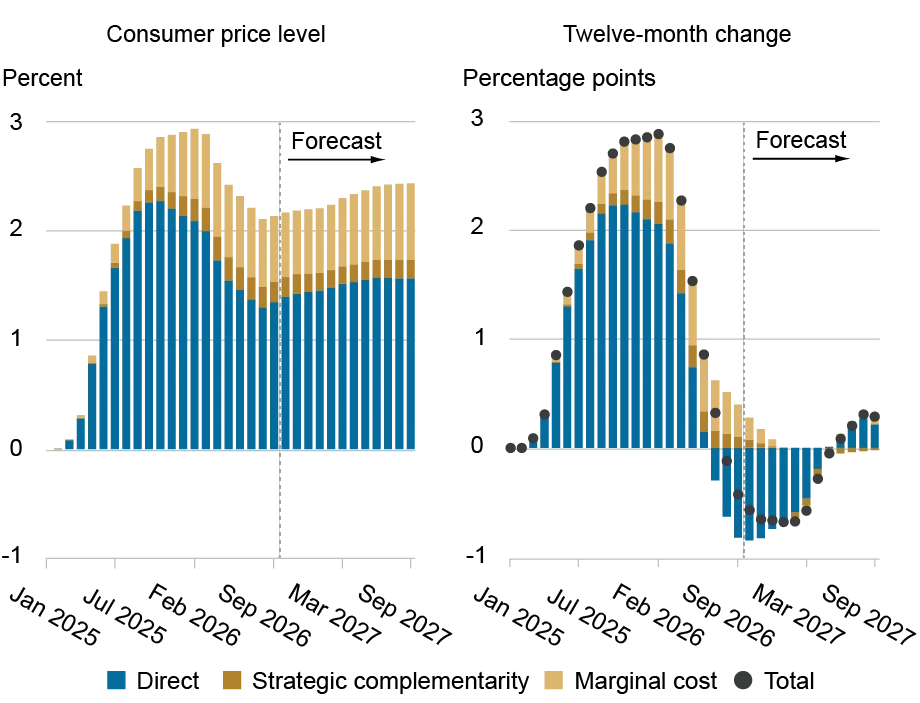
Ultimately, this analysis illustrates that about 25% of tariff impacts weave their way into consumer prices, with both direct and indirect channels contributing significantly. Import prices feel near immediate effects, while domestic prices experience a more lagged response, culminating in full impact estimates occurring around one year post-tariff implementation.


