Side A · Liner notes
Investment Response to Monetary Policy Varies Widely Among Firms
Banking · Words by David Garcia · Released
Research indicates most firms show minimal response to monetary policy changes, with significant variations based on firm size, age, and other characteristics.
Recent research conducted by Thomas Drechsel, Daniel Lewis, Davide Melcangi, and Laura Pilossoph highlights the diverse responses of firms to monetary policy changes, particularly regarding their investment decisions. While it is widely recognized that monetary policy significantly impacts these decisions, the study investigates which firms are most sensitive to interest rate shifts and how this sensitivity changes over time. The findings underscore that the majority of firms exhibit limited investment responsiveness, with only a small subset demonstrating considerable reaction to economic shifts instigated by policy changes.
Evaluating Investment Responsiveness to Monetary Policy
The analysis builds on existing literature that estimates firm-level investment responses to unexpected changes in monetary policy. It particularly references the framework established by Ottonello and Winberry (2020), where monetary policy surprises are quantified by alterations in the federal funds rate, as indicated by futures contracts surrounding policy announcements. Investment is measured through changes in the capital stock growth rate for publicly listed firms available in the Compustat database.

Unlike traditional studies that typically contextualize the effects of monetary policy through specific firm traits—such as size or financial health—this research adopts a broader framework. It focuses on understanding the entire distribution of investment responses to monetary policy changes, summarized as the Response of Investment to Monetary Policy (RIMP). This approach is distinctly agnostic to underlying drivers of investment response, allowing the researchers to analyze the RIMP without bias toward specific factors. After derivation, the researchers delve deeper into understanding what might influence these responses.

Distribution of Investment Responses
The study's results reveal a distribution of RIMP that displays most firms responding minimally to shifts in monetary policy. Nevertheless, the data indicates that some firms exhibit a pronounced reduction in investment levels following interest rate hikes. Specifically, for a small percentage of firms—approximately 5%—a one percentage point increase in the federal funds rate leads to a significant, corresponding four percentage point drop in their capital growth rates.

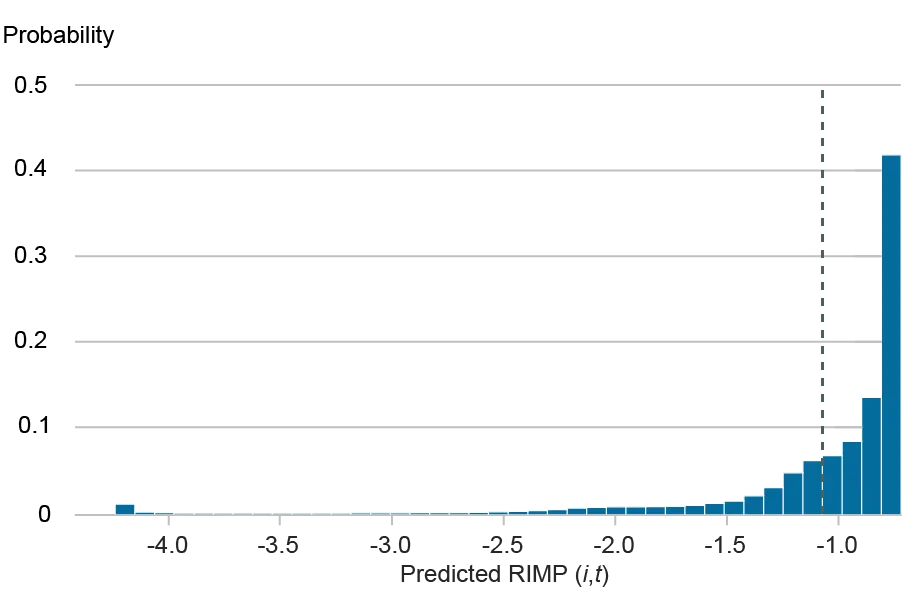
Notes: The chart illustrates the predicted response of investment to monetary policy (RIMP) at the firm-quarter level. The vertical dashed line indicates the homogeneous RIMP.
Characterizing Firm Sensitivity to Interest Rate Changes
Upon estimating the RIMP distribution, the authors further explore the drivers of substantial investment responsiveness to monetary policy shocks. Their analysis segments the variance into three main components: permanent firm variation, aggregate time variation, and within-firm time variation. The findings indicate that common factors explaining variation in the RIMP across firms are minimal. A noteworthy proportion corresponds to permanent differences among firms, but the bulk of variation is tied to intra-firm changes over time. This suggests that a given firm's investment may react strongly to a monetary shock during a specific quarter but remain largely unresponsive in subsequent quarters.
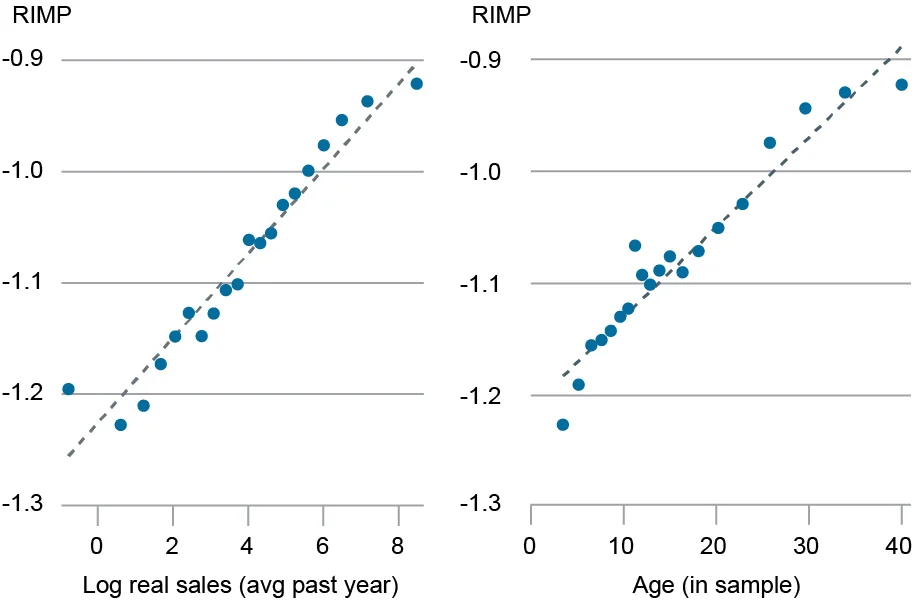
Notes: This chart represents the relationship of predicted investment responses to firm size and age, with dashed lines indicating fitted linear regressions.
Identifying Key Firm Characteristics
The study dives deeper into specific firm characteristics that consistently influence investment responsiveness. Previous research, such as that by Gertler and Gilchrist (1994), indicates that smaller firms tend to be more reactive to monetary changes, while findings from Cloyne et al. (2024) emphasize the heightened sensitivity of younger firms. Aligning with these insights, the current research confirms that both size and age significantly affect investment responses to policy shifts, with small and young firms exhibiting the most pronounced RIMP.
Furthermore, the data suggests that firms with shorter debt maturities react more strongly to changes in monetary policy. Additionally, behavioral factors like perceptions of discount rates and costs of capital are correlated with investment responsiveness. Notably, firms expressing greater optimism cut back on investment less when faced with interest rate increases.
These characteristics illustrate the complex interplay of factors influencing investment behavior. The joint impacts of multiple characteristics become evident, revealing that while many traits can predict investment responses, a substantial portion of variation remains unexplained, suggesting the presence of additional unobservable influences.
Key Takeaways and Implications
The findings offer fresh empirical evidence on how investment reacts to monetary policy adjustments. Although all firms tend to decrease investment amid interest rate hikes, the extent varies dramatically; most firms exhibit minor adjustments, while a few display significant changes. This heightened sensitivity to monetary surprises appears to be temporary—firms that are responsive one quarter may not exhibit the same volatility subsequently. Importantly, the study confirms that particular characteristics, especially firm size and age, are vital indicators of investment responsiveness, while highlighting that much variability is driven by unrecognized factors.
As policymakers and financial analysts continue to monitor economic conditions, understanding these dynamics is crucial. Recognizing the diverse landscape of firm responses can enhance strategies for mitigating adverse impacts of monetary tightening on investment decisions and contribute to more informed policy formulations.


