Side A · Liner notes
China's Electric Industry Fuels Surge in Trade Surplus Through Advanced Technology Exports
Banking · Words by Robert Miller · Released
China's investment in electric technologies has driven impressive growth in exports, particularly in electric vehicles and lithium-ion batteries, reshaping its trade dynamics.
China’s strategic investment in advanced electric technologies, notably electric vehicles, lithium-ion batteries, and solar panels, has not only transformed its domestic markets but has significantly altered its international trade landscape. As these sectors advance in quality and reduce in price, global demand has surged, creating a marked increase in China’s trade surplus. However, the dynamics vary within the sectors, particularly with passenger vehicles and batteries seeing substantial growth, while solar panel revenues have suffered due to overproduction.
Government Commitment and Industrial Policies
The impetus behind China’s focus on electric technology can be traced back to initial concerns about pollution, evolving into a broader ambition to lead in emerging technological markets. This shift was formalized in the Five-Year Plans: the 2011 plan aimed to boost the share of electricity supplied by non-fossil fuels, while the 2016 and 2021 plans specifically targeted environmental technologies, including electric vehicles and renewable energy production. The latter underscored an ambitious goal of transitioning to a 50% battery-powered passenger vehicle market by 2035, setting the foundation for rapid technological growth.
The outcomes of these policies are becoming evident. By 2025, plug-in electric vehicles (including both battery electric and plug-in hybrids) accounted for 54 percent of total passenger cars sold, a significant leap from 28 percent in 2022. Concurrently, solar power capacity soared with an addition of 360 gigawatts (GW) in 2024, illustrating that the ramp-up in capacity is partly catering to international markets.
Growth in Motor Vehicle Exports
China’s rapid pivot towards plug-in vehicles is particularly noteworthy, achieving the ambitious 50% target a decade ahead of schedule. Vehicle production figures tell this story clearly: battery electric vehicle (BEV) production skyrocketed from 1 million units in 2020 to an estimated 9.5 million units by 2025, while production of plug-in hybrids surged from 200,000 to over 4.5 million. Historically a market where China had limited global presence, the investment in electric vehicles has allowed the nation to leapfrog over established competitors.
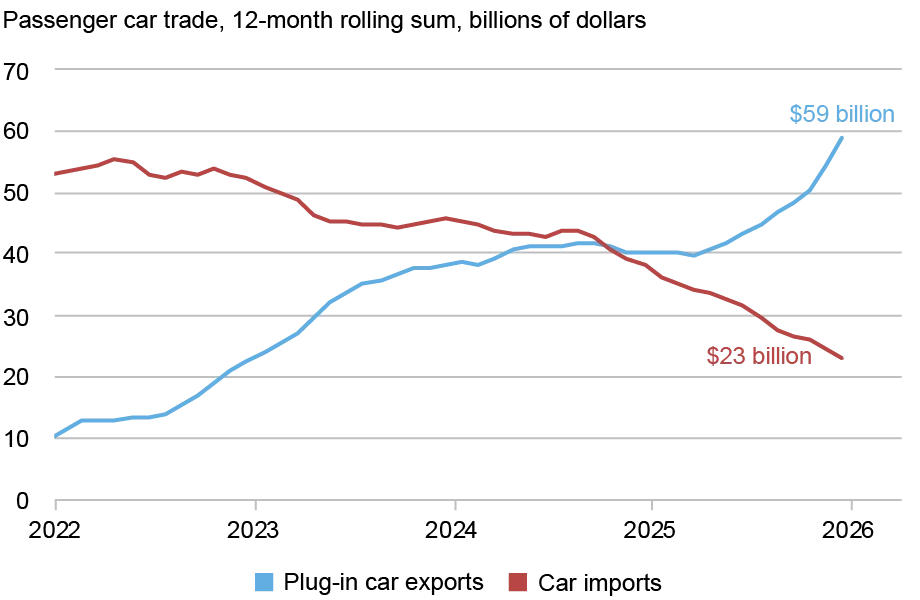
This dramatic increase in production has been reflected in export figures, which jumped from $3 billion in 2020 to $23 billion in 2022 and projected to reach $59 billion by 2025. These statistics are particularly significant given the existing tariffs that restrict access to major markets like the U.S. On the import side, China's burgeoning domestic plug-in vehicle production has led to a decline in passenger car imports, which fell from $52 billion in 2022 to $23 billion in the following year. The compositional shifts in trade, with rising plug-in exports and diminishing imports, contributed $65 billion to a total of $270 billion increase in China's trade surplus from 2022 to 2025.

Lithium-Ion Battery Exports
The advancement in lithium-ion battery technology underpins much of the growth in the electric vehicle sector. As these batteries become more efficient and less expensive to produce, a remarkable trend has emerged: many electric vehicles manufactured elsewhere rely heavily on batteries produced in China. Additionally, the global shift towards renewable energy has catalyzed demand for batteries, as countries increasingly utilize solar and wind power.
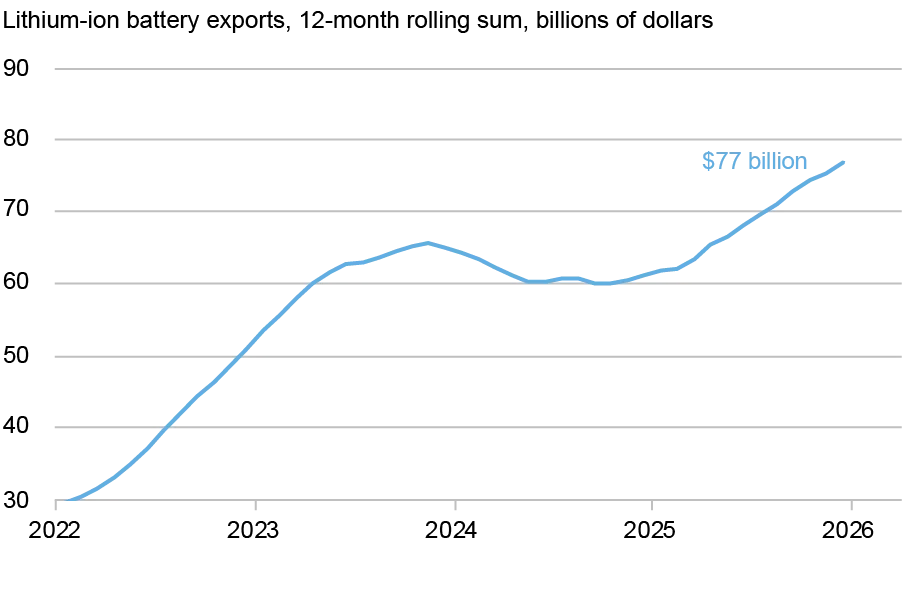
The growth of China’s battery exports mirrors that of its vehicle exports, although 2024 saw a pause in this upward trend following substantial growth the previous year. By 2025, exports are positioned to reach $77 billion, marking a 50% increase compared to 2022’s figures of $51 billion. Notably, China's imports of batteries during this time have been negligible, showcasing that battery production significantly bolsters the trade surplus.

Moreover, Chinese firms maintain a dominant position in the lithium-ion battery import market; reports indicate that in 2024, the U.S. and EU sourced about $25 billion worth of such batteries, with China accounting for 70% of U.S. imports and an impressive 86% of EU purchases. This trend extends globally, with high percentages reported in markets like India (91%), Pakistan (99%), Brazil (80%), and Saudi Arabia (98%).
The Solar Panel Market
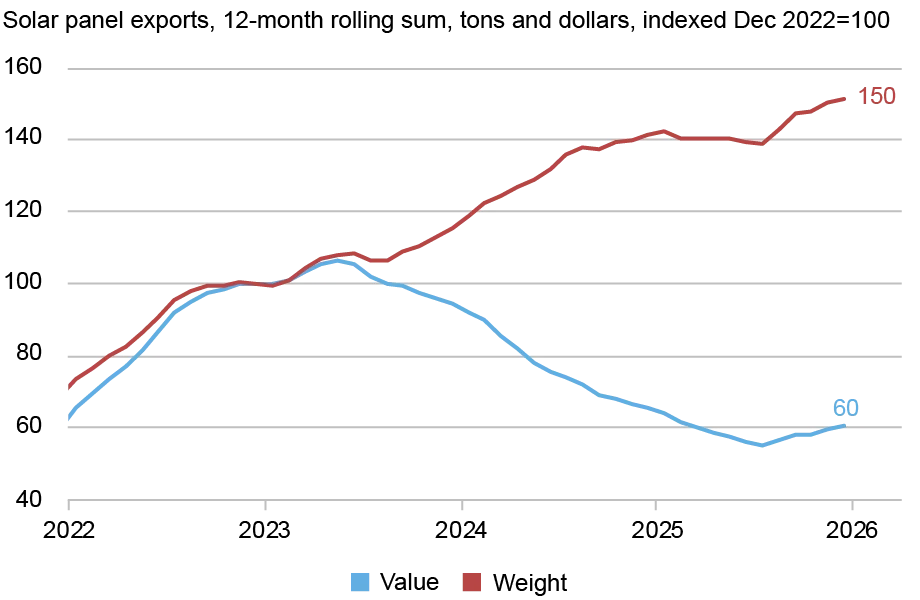
In contrast, the international solar panel market has demonstrated a mixed performance for China. Despite investing heavily in solar capacity, with global capacity additions increasing from 150 GW in 2022 to an estimated 250 GW in 2024, China’s solar panel export revenues significantly declined—from $46 billion in 2022 to $28 billion by 2025. This downturn is attributed to a supply glut that reduced prices, meaning that even with increased export volumes, revenue continues to lag.
The data illustrates a complex interaction between price and volume in the solar panel sector. For instance, while stable prices led to parallel growth in value and weight of exports from 2022 into early 2023, falling prices resulted in lower revenues despite a rise in volume later on. Nevertheless, China's dominance in this market remains unchallenged; in 2024, Chinese panels accounted for virtually all imports into the EU and substantial shares in other markets, including India and Saudi Arabia, despite high tariffs limiting imports into the United States.
Future Outlook
The demand for advanced electric technology products remains robust globally, with China poised to maintain its dominant position in this space. Such a position is bolstered by the nation's ability to produce high-quality, competitively priced goods. Still, there is potential for increased competition from other East Asian economies, presenting a challenge for governments looking to establish domestic industries that can compete effectively with China's industrial output.
Policymakers around the world must grapple with the implications of fostering local alternatives while weighing the economic costs and benefits against reliance on China's established supply chains. The growing complexities of these trade dynamics could reshape the electric technology landscape, warranting close scrutiny as developments unfold.

Thomas Klitgaard is an economic policy advisor in the Federal Reserve Bank of New York’s Research and Statistics Group.


