Side A · Liner notes
Understanding the Global Credit Cycle and Its Impact on Corporate Bond Returns
Banking · Words by Thomas Rodriguez · Released
The global corporate bond market, valued at $19 trillion, exhibits significant synchronization in returns influenced by a newly defined global credit factor.

The global corporate nonfinancial bond market represents a substantial investment asset class, culminating in a value of $19 trillion by the end of 2024. This portfolio includes over 10,000 bonds across various industries, credit ratings, and regions. Notably, between 1998 and 2024, more than 80% of these bonds moved in the same direction in 37% of months, signaling a strong synchronization in returns. This phenomenon leads to the introduction of a new concept, the global credit factor, which serves as a proxy for the global price of risk in corporate bond markets, thereby establishing a global credit cycle that influences bond risk premia and predictable comovement in bond prices.

Measuring the Global Credit Cycle
The question arises: does a global credit cycle exist within corporate bond returns? To examine this, researchers developed a proxy named the global credit factor, relying on theories surrounding intermediary asset pricing that suggest risk prices are indicative of the balance sheet health of financial intermediaries. Given that these constraints can differ over time, risk prices are also expected to fluctuate.
The researchers structured their analysis by creating portfolios categorized by credit ratings—AAA/AA, A, BBB, and high yield—to inform the global credit factor from both historical returns and changes in returns corresponding to varying levels of credit risk. This predictive modeling focuses on understanding how risk attitudes affect not just realized returns, but also expected returns, thereby capturing the pricing of credit risk.
Key observable predictors for assessing the tightness of balance sheet constraints include the average default-risk-adjusted spread for U.S. bonds, termed the excess bond premium (EBP), alongside the Chicago Board Options Exchange’s Volatility Index (VIX). Previous research, notably by Gilchrist and Zakrajsek in 2012, indicates that EBP reflects the risk appetite of financial market intermediaries, and it appears that the global credit factor also integrates broader risk attitudes among financial players, hence the utilization of the VIX.

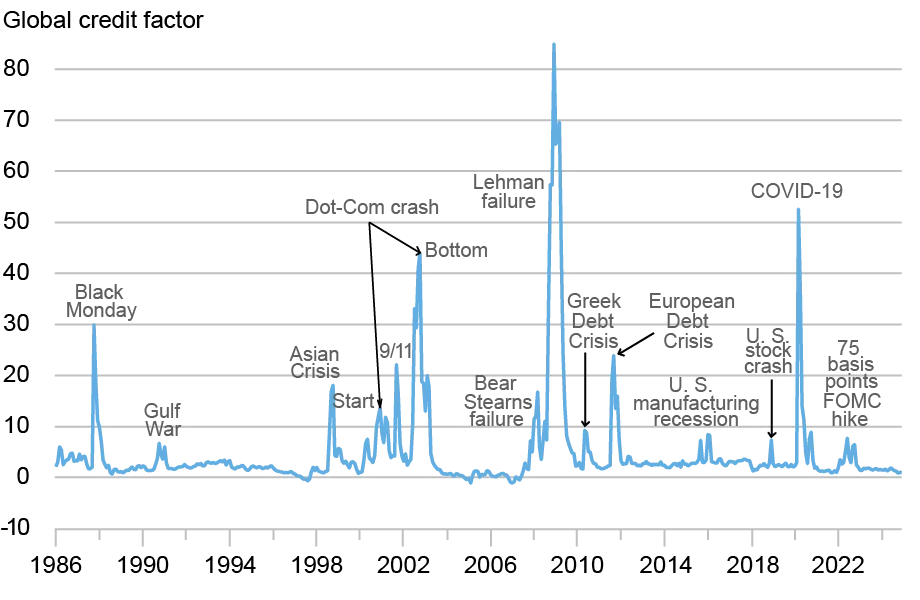
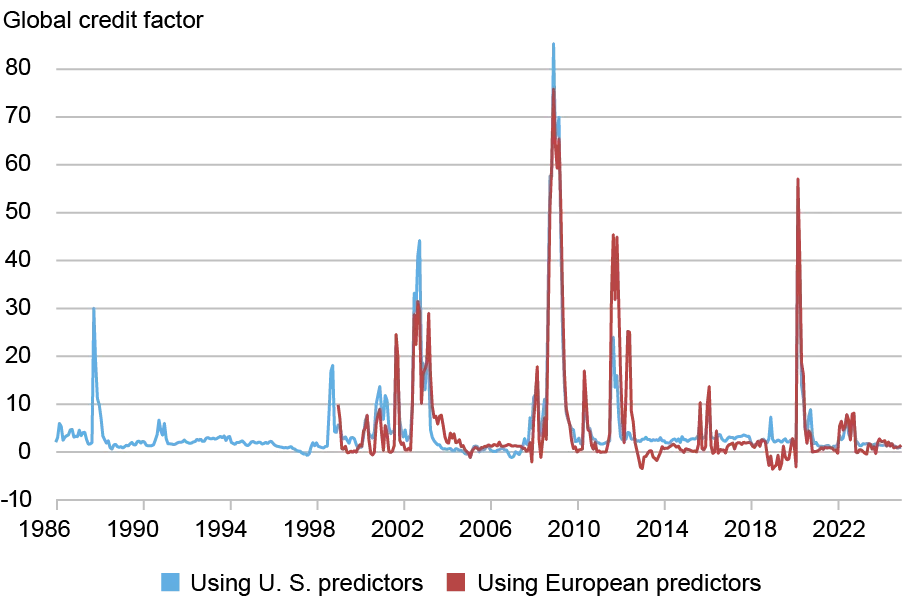
The accompanying time series data illustrates the estimated global credit factor alongside notable historical events. It indicates tightening of the factor when both the VIX and the EBP are elevated, a pattern observed during crises such as the COVID-19 pandemic in March 2020 and post-Lehman Brothers' collapse in Fall 2008. Conversely, the factor is at its lowest during periods of favorable risk sentiment, such as before the Asian financial crisis and the global financial crisis.
Nonlinear Relationships in the Global Credit Cycle
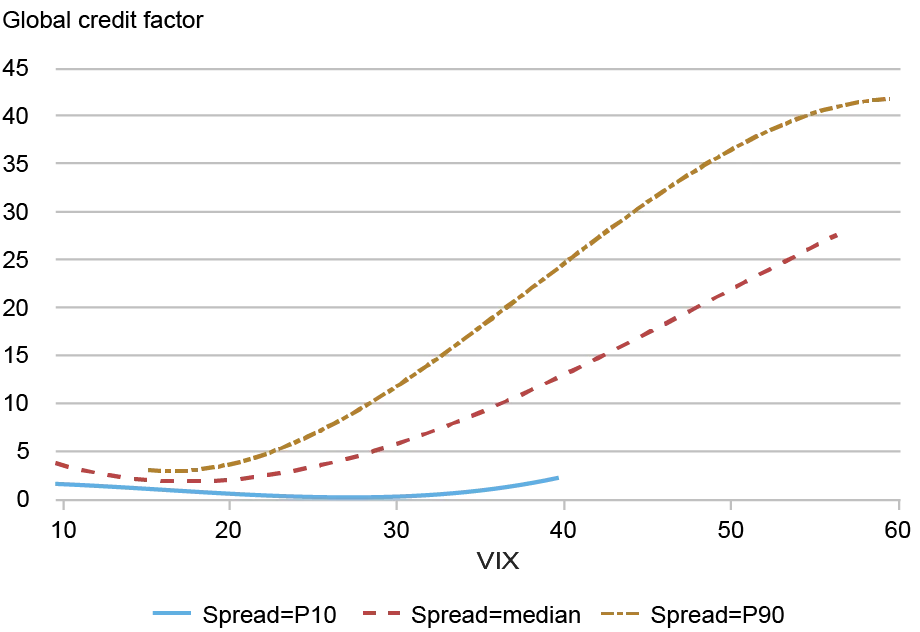
When analyzing the correlation between the global credit factor and the VIX, findings reveal a highly nonlinear interaction. Below the historical median VIX level of 18, the global credit factor remains relatively unchanged, regardless of the credit spread level. However, when the VIX exceeds the median, the slope of the global credit factor in response to the VIX amplifies as credit spreads increase, highlighting how elevated volatility interacts with credit conditions to shape the price of risk.
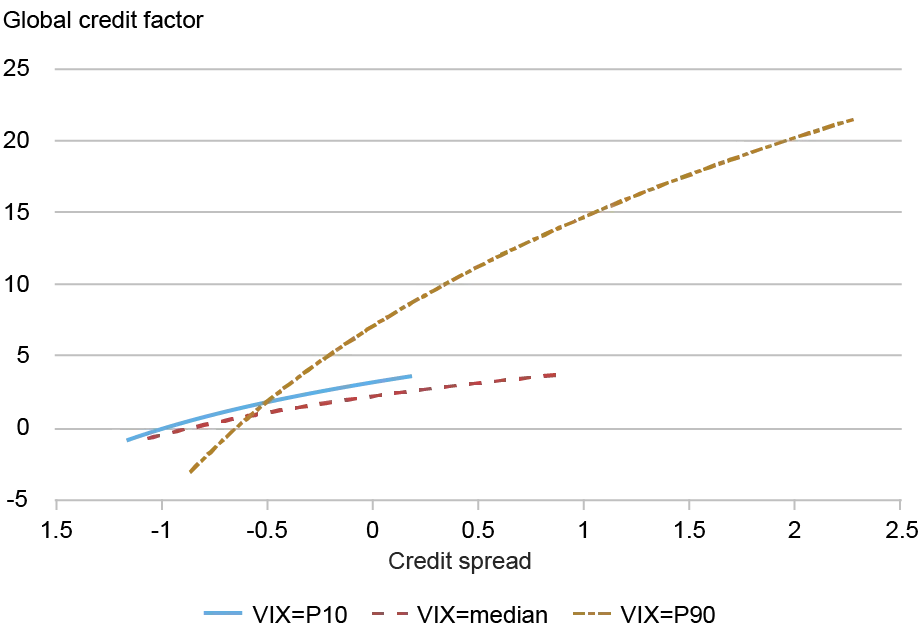
A similar nonlinear relationship emerges when examining the global credit factor's sensitivity to the EBP. High levels of the VIX lead to increased sensitivity of the global credit factor to variations in credit spreads, suggesting that external financial pressures significantly influence credit risk pricing.

Examining Global Applicability of the Credit Factor
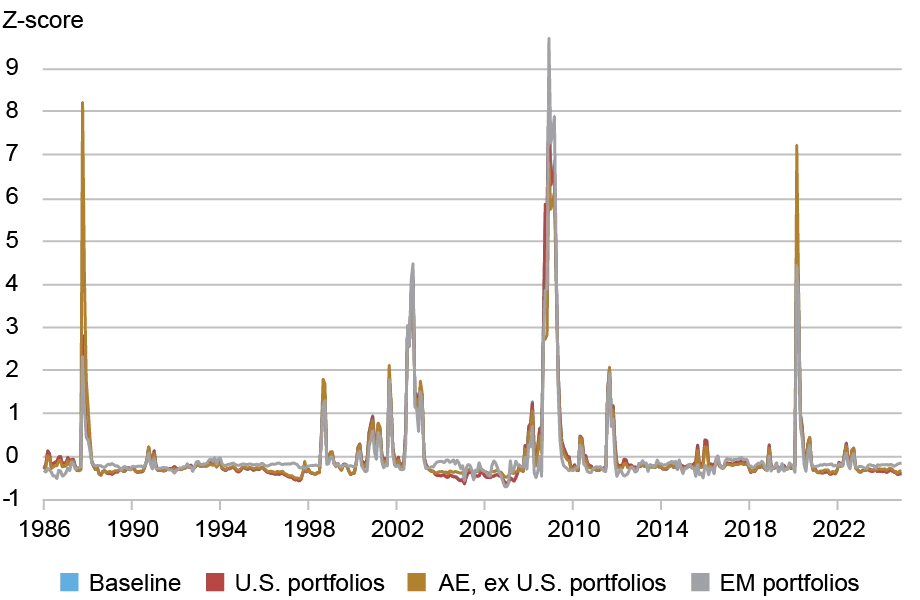
Investigating whether the global credit factor genuinely reflects global financial conditions, the authors conducted two key analyses. In the first, they maintained the same predictors—U.S. EBP and VIX—and assessed how the global credit factor varied with different portfolios. Their findings indicated that the estimated time series for global credit risk remained consistent across various portfolio types, such as U.S. corporations, advanced economies exclusive of the U.S., and bonds from emerging markets. This consistency is striking, given that the non-U.S. bond return data only became available starting in 1998.
In the second exercise, researchers replaced U.S.-based predictors with European ones, utilizing the Euro Stoxx 50 Volatility (VSTOXX) and a spread average from eight major European nations. The results showed that while the credit factor based on European data resembled the global credit factor, it also reflected local economic events more strongly, such as a pronounced tightening during the European debt crisis, where the U.S.-centric measure did not identify the same degree of pressure.
Conclusion: Interconnectedness of Credit Markets
The exploration of global credit markets reveals their interconnected nature, governed by a shared component that dictates global corporate bond returns. The research illustrates that elevated levels of the global credit factor predict higher corporate bond returns and a deterioration in local credit conditions, often corresponding with outflows from global bond funds. Ultimately, the global credit factor emerges as a valuable proxy for understanding the time-varying global price of credit risk.

Nina Boyarchenko and Leonardo Elias are financial economists at the Federal Reserve Bank of New York.


