Side A · Liner notes
The Economic Implications of AI: Navigating Challenges and Opportunities
Banking · Words by Christopher Johnson · Released
AI's current capital-intensive model raises short-term costs without immediate productivity gains, presenting inflation and financial stability risks.

In the third quarter of 2025, the financial landscape for America’s largest technology companies underwent a significant shift. For the first time, these firms allocated more towards capital investments than they generated from operational earnings. This disparity signals a crucial moment in the AI sector, suggesting that, at present, artificial intelligence is consuming resources more rapidly than it can produce returns. This article delves into how this duality between AI's long-term potential and its immediate costs influences inflation, economic activity, and financial stability.
Three Interconnected Channels Affecting the Economy
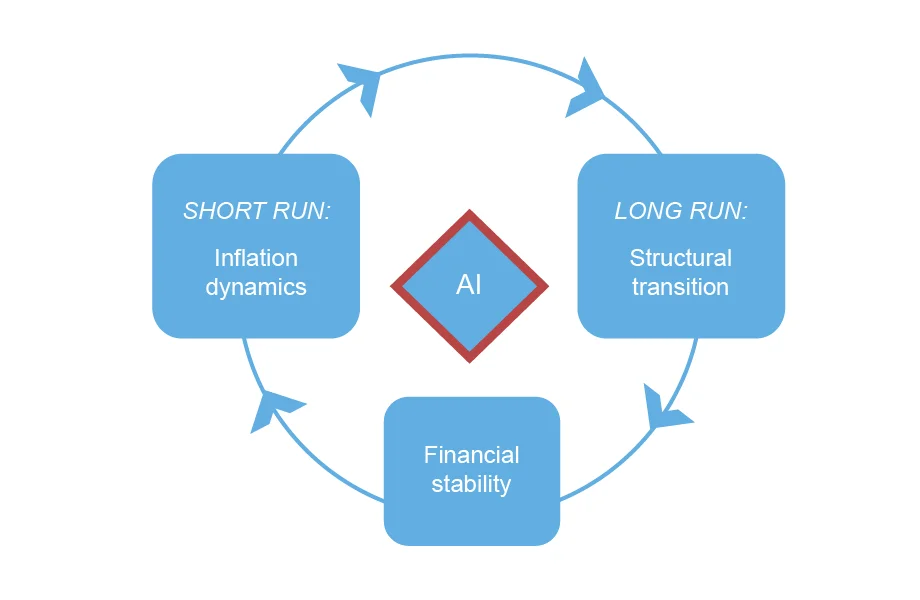
There are three critical interconnected channels through which the integration of AI impacts the economy: inflation dynamics, structural transitions, and financial stability. This framework serves to clarify the complexities surrounding AI adoption and its macroeconomic implications.
Inflation Dynamics
In the short term, the adoption of AI can alter the traditional relationship between interest rates, inflation, and economic activity. Many economists believe that increased productivity from AI represents a strong disinflationary force. However, this perspective may overlook a vital aspect: the impact of the costs associated with implementing AI technologies. The key factor for inflation is whether productivity gains from AI can outpace the rising costs linked to its adoption.
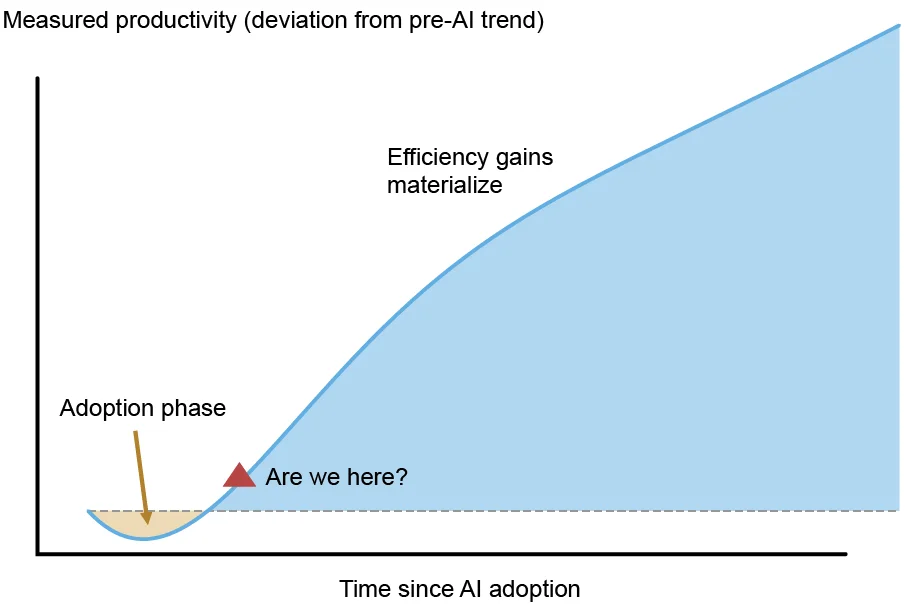
During the transition phase to AI systems, companies often redirect significant resources to reorganizing their operations, enhancing data infrastructure, and integrating new technologies. These efforts can temporarily inflate production costs, even as advancements expand the technological frontier. This phenomenon is characterized by the "productivity J-curve," illustrating that productivity metrics could diminish before realizing long-term gains.
Data indicates that in 2025, major AI firms such as Google, OpenAI, and Amazon invested approximately $300 billion into capital projects, primarily within semiconductor supply chains and specialized labor markets. Such aggressive spending trends continued into early 2026, contributing to cost pressures at various levels across the economy.
Recent analysis points towards rising prices in consumer electronics driven by AI demands. Reports show that prices for memory chips have surged significantly, along with energy consumption and costs tied to AI innovations.

Long-Term Structural Transitions
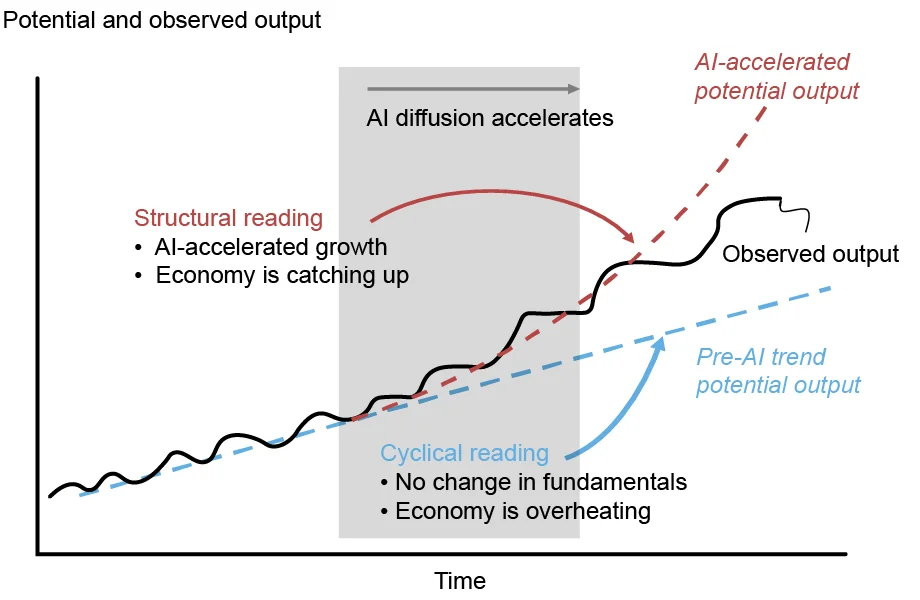
Looking towards the future, AI stands to redefine economic indicators such as potential output levels and the natural rate of interest. The pressing question remains: does AI lead to a one-time enhancement in productive capacity, or does it enable sustained economic growth? A temporary increase during the transition phase could raise the natural interest rate, but a genuine acceleration of growth may establish a lasting impact on the economy.

Current estimates of AI's productivity impacts span a wide range, from minimal gains of a few percentage points of GDP over a decade to considerably more substantial advantages if AI spurs the innovation process itself. This variance highlights significant uncertainty, compounded by factors like increased market concentration and shifts in consumer behavior. The inclination towards AI typically favors larger firms, potentially skewing economic benefits towards a small group of incumbents. If this dynamic results in wider economic divides, it could undermine the overall scope of innovation and sustainable growth.

Financial Stability Risks
The financial system is undergoing transformation due to AI. Historically, major AI companies primarily funded their capital expenditures from retained earnings, insulating their investments from external credit conditions. This trend shifted dramatically in late 2025, as capital expenditures started to exceed operating cash flows, prompting firms to procure over $100 billion in new debt. This new layer of debt financing, including off-balance-sheet project financing for data centers and complex securitizations, relies on AI productivity gains that have not yet been realized.

If market expectations surrounding these investments falter, the repercussions would likely extend throughout the financial industry. Institutions such as insurers and asset managers, which hold overlapping exposures across various types of financial instruments, could experience widespread repercussions from a significant reevaluation of these assets.
Understanding the Central Challenges
The interconnected channels of inflation, structural change, and financial vulnerability respond to each other's dynamics, complicating the economic landscape. Consider the scenario where AI adoption raises costs initially without translating into productivity gains, leading to inflationary pressures. Meanwhile, firms’ production costs can escalate due to elevated demand for resources in input markets. Expectations of future productivity briefly sustain asset valuations, prolonging the discrepancy between delivery and returns.
The resultant economic phenomenon may be likened to a "centrifugal bind," where divergent forces exacerbate opposing trajectories. Elevated inflation could erode asset prices that are predicated on now-distant productivity advantages, potentially leading to financial instability just as the measures for supply-side benefits have yet to manifest.
Rethinking Economic Response Timelines
AI challenges traditional economic theories regarding policy response times. Milton Friedman’s notion of “long and variable lags” around policy effectiveness—where monetary policy impacts inflation and economic activity over prolonged and unpredictable periods—comes under pressure due to AI’s rapid deployment. AI can compress some response lags, accelerating adjustments in pricing due to algorithmic responses and more agile market behaviors while simultaneously elongating others due to organizational frictions in adapting to new technologies.
A Cautionary Tale from History
The IT boom of the 1990s offers pertinent lessons. Alan Greenspan, then Fed Chairman, opted against premature tightening, endorsing the notion that the IT revolution was amplifying productive potential. While he ultimately proved correct, the ensuing dot-com crash illustrated how investor expectations can fuel asset dynamics, culminating in financial risks independent of economic fundamentals. Today's AI cycle bears similarities—characterized by productivity uncertainties and the challenge of distinguishing between supply and demand drivers—but it occurs against a backdrop of a highly intricate financial system.
In summary, the trajectory toward a more AI-driven economy may unfold with significant volatility, as macroeconomic indicators will likely reveal multi-dimensional complexities influenced by both near-term costs and long-term potential.


