Side A · Liner notes
Understanding Investors' Uncertainty Surrounding R-Star through Bond Yields
Banking · Words by Thomas Garcia · Released
Monetary policy decisions are increasingly influenced by bond investors' perceptions of R-Star, revealing underlying uncertainties within economic indicators.
Monetary policymakers scrutinize sovereign bond yield curves to gauge market interpretations of future monetary policy, inflation trends, and economic activity. A focal point in this analysis is the natural real rate of return, commonly referred to as “r-star.” This rate plays a critical role in guiding monetary policy decisions. In a recent Staff Report by the Federal Reserve Bank of New York, researchers delve into how term structures of interest rates provide insights into the perception and uncertainties associated with r-star among investors.
Analyzing Economic Variables Through Investor Perceptions
To dissect the complexities surrounding r-star, the researchers constructed a bond pricing framework that addresses the issue of incomplete information. This model posits that aggregate macroeconomic indicators fluctuate due to enduring trends and transient cycles, a distinction investors struggle to identify in real time. For instance, if investors observe a short-term interest rate of 5%, along with inflation and growth rates, they might infer a trend of 2% and a cycle of 3%. Such inferences are inherently flawed as they depend on investors' imperfect understanding of actual economic states, yet they reflect the best possible assessment given the available data.
This framework highlights a significant mechanism: when determining bond yields, investors reference their subjective understanding of longer-term trends and cyclical movements in interest rates. Consequently, the resulting bond yield is a function of perceived trends and cycles, offering policymakers valuable signals about market sentiment, as long as investors have access to different information than the policymakers themselves. It is crucial to note that the insights derived from the term structure are only as reliable as the information that investors hold.
Constructing a Realistic Bond Pricing Model
The researchers then embedded this mechanism into a practical bond pricing model incorporating real data. In this model, investors can observe three core macroeconomic variables: interest rates, inflation, and growth, but they cannot directly assess the long-run versus short-run components of these variables. The researchers applied financial metrics to define r-star as the difference between the nominal interest rate trend and the inflation trend. Additionally, a factor of private information, unbeknownst to econometricians, informs investor predictions about the economy’s long-term trajectory.

Revealing Investors' Uncertainty
Utilizing quarterly yield curve and macroeconomic data from the 1960s onward, the study derived several critical insights. Firstly, while the trends in interest rates, inflation, and growth identified by investors shifted slowly, the confidence intervals surrounding these estimates were significantly wide. For instance, as of late 2022, the model indicated an investor-perceived i-star at 3.75%, with a broad 95% confidence interval ranging from 1.55% to 5.95%. This level of uncertainty highlights the challenges investors face when estimating key economic indicators that drive financial outcomes.

Investigating the Perception of R-Star
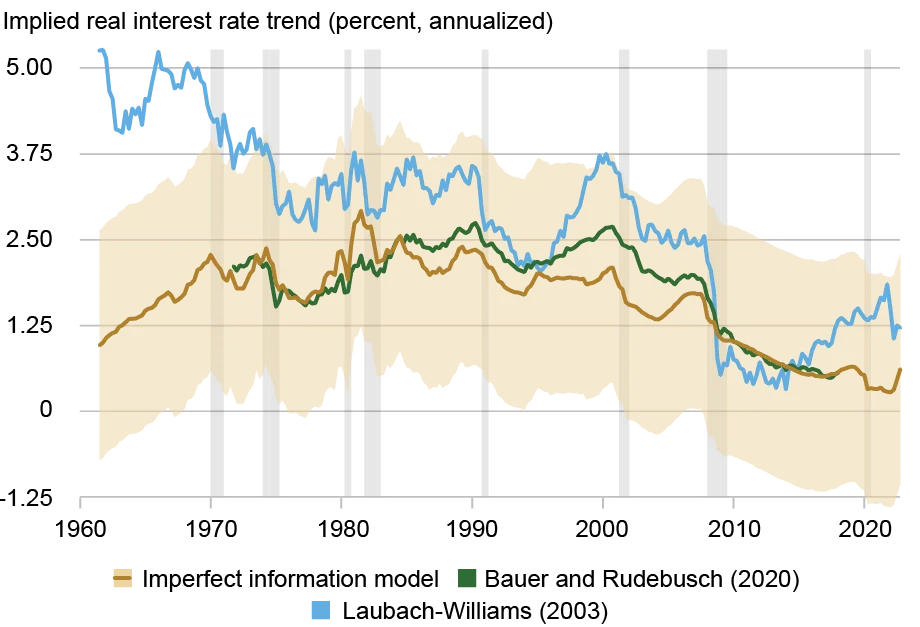
With the articulated time series and parameters, the study was able to extract subjective time series estimates of r-star along with associated uncertainties, determined through the comparison of i-star and pi-star. The perceived r-star trend, illustrated in the findings, remains relatively stable from the 1960s to 2022, fluctuating between 0% and 2.5%. This stability contrasts sharply with more volatile estimates found in prior studies, such as those by Laubach and Williams (2003) and Bauer and Rudebusch (2020), suggesting a more consistent investor perception of r-star over time.

In particular, the same model indicated a significant degree of uncertainty around the estimated r-star, with 95% confidence bands approximating ±170 basis points, situating the Laubach-Williams estimates within these ranges throughout the 1970s. This contention fosters a more nuanced understanding of how investors project r-star when faced with fluctuating market conditions.
Real-Time vs. Two-Sided Estimates of R-Star
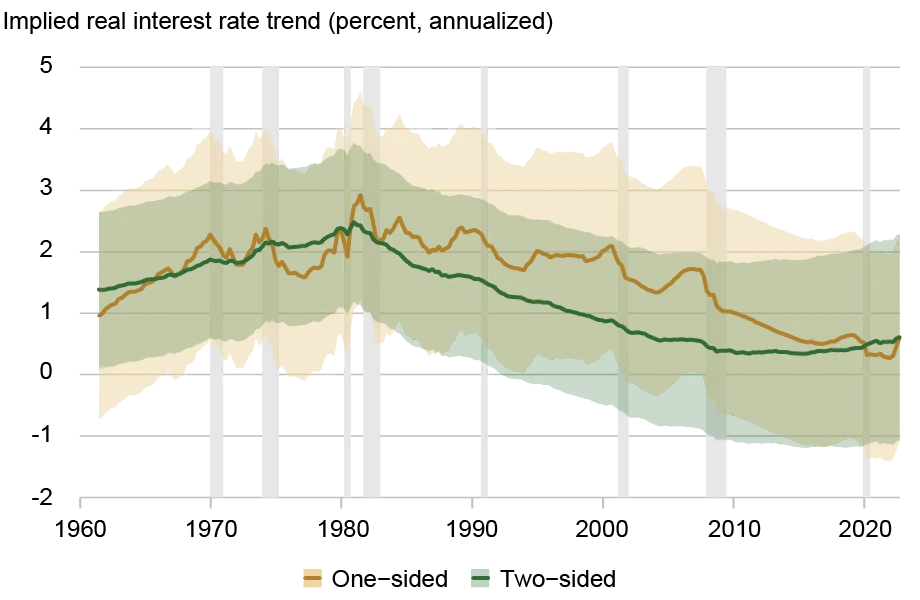
The researchers further examined the implications of real-time estimates of r-star, demonstrating that investors relied only on information available up to any given time, leading to an inherently gradual increase in r-star estimates compared to other financial models. This has prompted speculation regarding whether the low r-star phase is truly over. Alongside, two-sided r-star estimates revealed persistent uncertainty: confidence bands remained broadly even when hindsight was applied, estimating ±130 basis points in uncertainty. This indicates that historical judgment often portrays a more restrictive monetary policy environment than what was believed at the time.
Implications for Policymakers
Ultimately, the findings suggest that the yield curve serves as a vital tool in uncovering investor perceptions regarding r-star, despite their imperfect knowledge of economic states at present. The considerable uncertainties surrounding r-star persist and do not diminish as time progresses, leading to a notable recommendation for policymakers: they should weigh financial-based r-star estimates alongside their uncertainty metrics more heavily in monetary policy decisions.

Guillaume Roussellet is a financial research economist at the Federal Reserve Bank of New York's Research and Statistics Group.


