Side A · Liner notes
The Stability of the U.S. Current Account Amid the AI Boom
Banking · Words by Julian di Giovanni · Released
Despite rising imports linked to the AI boom, the U.S. current account deficit remains stable due to unchanged investment and saving patterns.

As the artificial intelligence (AI) sector expands, its influence permeates various segments of the U.S. economy. Notably, this boom manifests in the realm of international trade, where imports of crucial components like semiconductors and computing equipment have surged. Despite these climbs, the U.S. current account deficit shows little significant alteration. This situation prompts an exploration into why the AI boom has not considerably impacted the trade balance.
Understanding the Current Account Dynamics
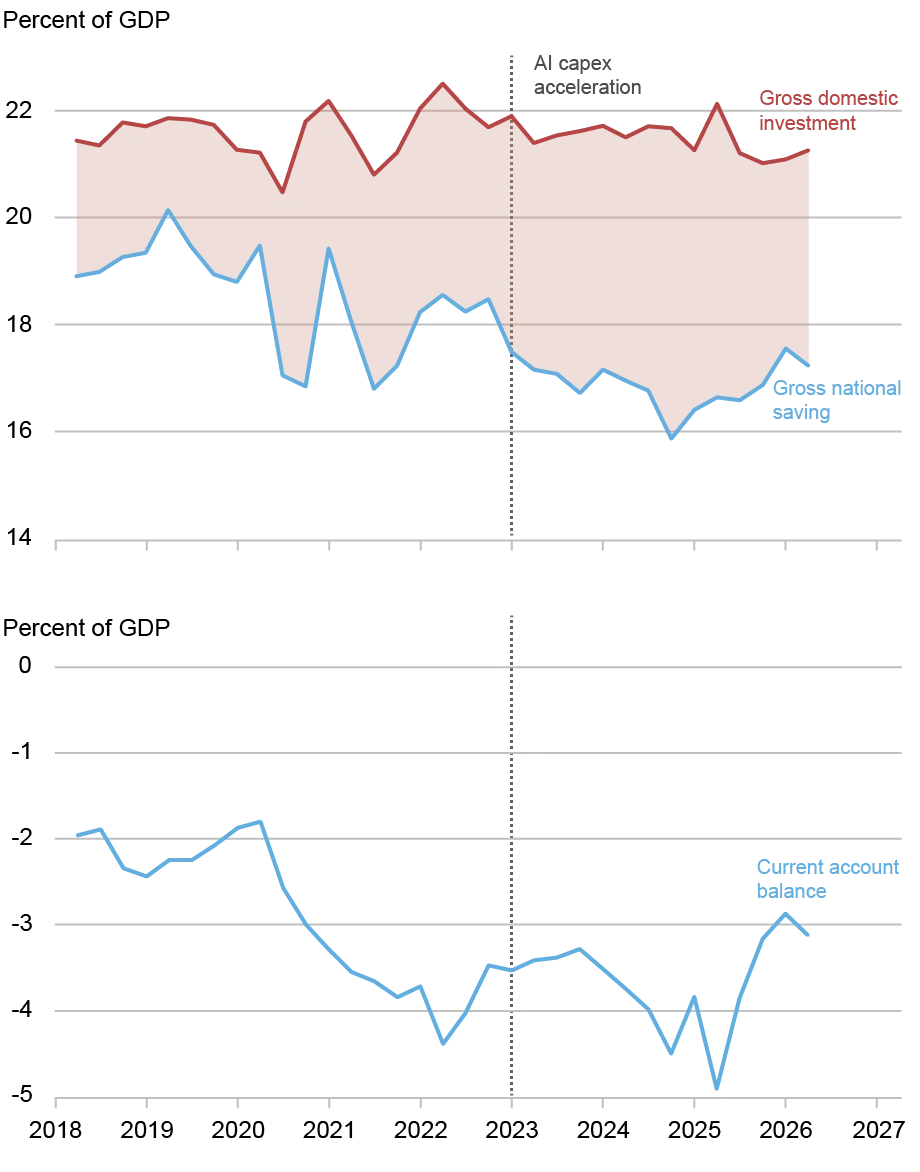
The current account is fundamentally shaped by the relationship between saving and investment within the economy. In the wake of the AI boom, two key facts emerge: overall aggregate saving and investment levels have remained relatively unchanged. Indeed, the growth in imports reflects substantial operations within the AI sector, but this does not correspond to an intensified current account deficit. This can be attributed to consistent domestic saving that offsets the uptick in investment.
Recent insights suggest that U.S. imports of AI-related goods peaked at 23% of total imports in 2025. However, the relationship between gross saving and gross domestic investment provides clarity: a nation can manage significant imports or foreign capital influx without triggering an increased external deficit if it retains adequate saving. Various studies, including a recent publication, delve into the nuances of how these economic metrics influence one another.
For the AI boom to induce a more expansive deficit, it would need to elevate investment levels beyond the accompanying rise in savings. This concept revolves around two potential pressure points on private saving: a wealth effect spurred by equity gains, leading to increased household consumption, or a downturn in business saving. Historical parallels can be drawn from the dot-com era, where both mechanisms significantly impacted the current account balance.

Investment Trends: A Reallocation, Not an Expansion
Investigating gross domestic investment reveals that it remained steady on average at 21.3% of GDP pre-pandemic and hovered around 21.5% during the initial period of AI capital expenditure expansion from 2023 to the first quarter of 2026. Notably, this stability indicates that the AI-driven investment surge is not prominently reflected in aggregate investment metrics.

Despite increased nonresidential investment linked to the AI sector, other economic areas have not experienced similar growth rates. While investment in data centers and information-processing equipment has increased and somewhat alleviated weaknesses in other sectors, it has not been adequate enough to substantially elevate aggregate figures relative to national savings. Additionally, a downturn in residential investment compounds this trend, further indicating a mixed investment landscape.

Consumption Patterns During the AI Boom
A compelling contrast emerges when examining savings behavior during the current AI boom versus the dot-com expansion. During the late 1990s, private savings saw a steep decline, falling nearly three percentage points of GDP as households utilized rising equity wealth for consumption. In stark contrast, the current savings rate has dipped only slightly, averaging about 20.8% of GDP from 2023, down marginally from 21.3% prior to the pandemic. This decline reflects more of an adjustment rather than a reaction directly driven by the AI sector.
The Resilience of Business Sector Saving
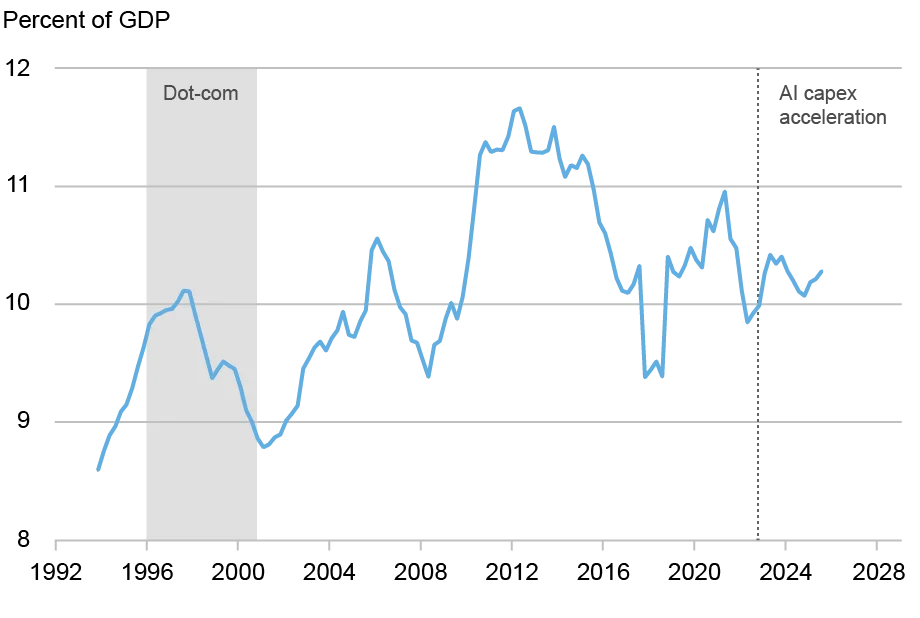
Another critical factor is the state of business saving, defined as revenue minus expenses without including investment spending. During the dot-com boom, business saving plummeted, negatively impacting private savings as investments peaked. Conversely, the current AI investment surge is primarily supported by more financially stable firms, resulting in robust business saving levels. Currently, the business sector averages a 10.9% savings rate, comparable to pre-pandemic figures and higher than the approximately 8.8% observed in the downturn during the dot-com period.
Government Savings: A Contrasting Trend
A notable divergence lies in government saving, which moved opposite to private saving trends. In the dot-com era, government saving skyrocketed, enabling it to offset the effects of rising private dissaving. Today, however, the government has seen a deterioration in its financial position, decreasing from a deficit of approximately –2.2% of GDP (2015-2019) to roughly –4.0% in the wake of the AI boom—a decline of about 1.75 percentage points, adding pressure to the current account situation.
Current Account Contributions: Breaking Down the Figures
When dissecting the factors influencing the current account balance since the pre-pandemic period, the widening of the saving-investment gap by about 2.4 percentage points reveals key contributors. Government dissaving accounts for a significant portion (approximately 1.75 percentage points), while lower private saving and minimal impacts from heightened investment provide additional context. These findings underline fiscal policy as the primary driver of shifts in the current account dynamic.
Looking Ahead: Potential Changes on the Horizon
As always, caution is warranted regarding potential future impacts of the AI sector on the current account. Major technology firms have ambitious capital spending plans slated for 2026 and 2027, significantly exceeding current capacities. If weaknesses in other investment areas diminish alongside an acceleration in AI capital expenditure, the current account deficit could increase due to heightened investment without corresponding business saving growth.
In summary, while the AI boom has been notable, its impact on the current account remains muted thus far due to stable investment and saving dynamics. Still, we could see shifts on the horizon that warrant close observation.

Julian di Giovanni serves as an economic research advisor for the Federal Reserve Bank of New York.


