Side A · Liner notes
Financial Capacity Drives Consumer Behavior, Signaling Risks Ahead
Banking · Words by PYMNTS · Released
Consumer spending may not align with sentiment, as financial capacity varies widely, highlighting distinct consumer groups and the associated risks.

The sentiment surrounding consumer spending often doesn't reflect the underlying economic realities. Instead, a more accurate focus is on the financial capacity of various consumer segments, as illustrated in the latest findings from the June 2026 PYMNTS Consumer Expectations Index (PCEI). This report reinforces that while overall consumer confidence may falter, spending persists among certain groups based on their financial health.

Dissecting Consumer Sentiment
According to the PCEI report titled, “The Three-Speed Consumer Economy: How Financial Capacity Is Rewriting Spending Behavior,” the current landscape shows that not all consumers are reacting uniformly to economic signals. While some groups possess sufficient savings and job security to continue their spending habits, others are more cautious, tightening their purse strings in search of value due to financial constraints. This divergence suggests that a single sentiment index falls short of capturing the complexity of actual purchasing behaviors.

Key Findings on Employment and Consumer Confidence
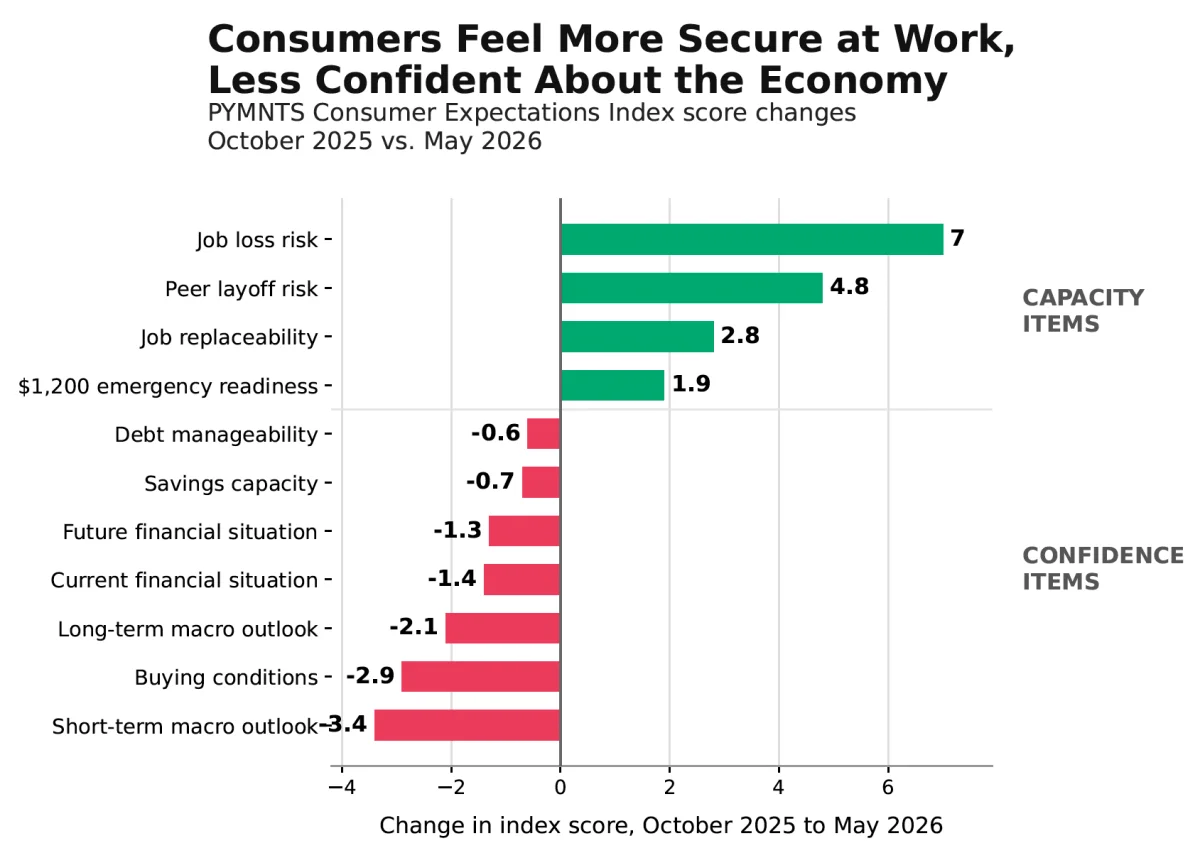
Recent statistics reveal a notable paradox between job security and consumer confidence. From October 2025 to May 2026, the perception of job-loss risk improved substantially, with a 7.0-point uptick in perceived job security, 4.8 points in perceptions of peer-layoff risks, and 2.8 points regarding job replaceability. However, the short-term macroeconomic outlook saw a decline, falling by 3.4 points, while consumer buying conditions dropped by 2.9 points.

This juxtaposition indicates that while consumers may feel less optimistic about the general economic environment, many still trust their personal job security, showcasing a mixed sentiment in consumer perspectives.

The Widening Consumer Gap
The PCEI highlights a widening disparity in consumer experiences, with a gap of about 21 points emerging between different consumer groups. Those who are not confined to living paycheck to paycheck registered a PCEI score of 61.9 in May. Conversely, consumers who do live paycheck to paycheck and struggle to meet their financial obligations saw their score dip to 40.6. The increase in the gap, up from approximately 18 points, is primarily a result of the lower-income group weakening rather than an uplift in those who are financially secure.

The middle-income segment, while still active, is demonstrating more selective spending behaviors. Consumers who fall into this category, representing those living paycheck to paycheck but without crippling financial woes, reported a stable PCEI score of 56.2. This group is defined by their focus on value, loyalty offers, bundled services, and the total cost of purchases, reflecting a shift towards a more calculated approach to spending.

Implications for Businesses
For businesses, the nuanced insights from the report present a strategic opportunity. The current economic climate is not fueled by unbridled optimism; rather, it is buoyed by households that maintain a sense of security in their employment, along with a middle class that remains accessible when marketing efforts are aligned with their values and needs. However, the pressing risk lies within the lower-income demographic whose financial resilience is eroding. Rigid payment conditions, unexpected fee structures, and one-time bills could provoke significant consumer losses if they do not navigate their financial pressure effectively.

To keep demand flowing, businesses can benefit from adopting flexible payment solutions—such as adjustable due dates, split payment plans, and low-cost liquidity options—that align with the realities of consumer finances.
Looking Forward
The overarching message conveyed by the PCEI report is that the average consumer should not be viewed as a homogenous entity. Businesses that can distinguish between the three distinct consumer groups are better positioned to safeguard their margins, nurture the value-focused middle market, and extend necessary support to those in financial distress. As consumer behavior continues to evolve in response to economic conditions, companies must remain agile and informed to adapt their strategies. Understanding these dynamics is crucial for sustaining growth and navigating the complexities of modern consumer behavior.