Side A · Liner notes
PREIT Files for Chapter 11 Bankruptcy as Retail Landscape Shifts
Banking · Words by Wolf Richter · Released
Pennsylvania Real Estate Investment Trust, or PREIT, has filed for a pre-packaged Chapter 11 bankruptcy, marking a significant restructuring as retail dynamics evolve.
Significant Moves Amid Retail Disruption
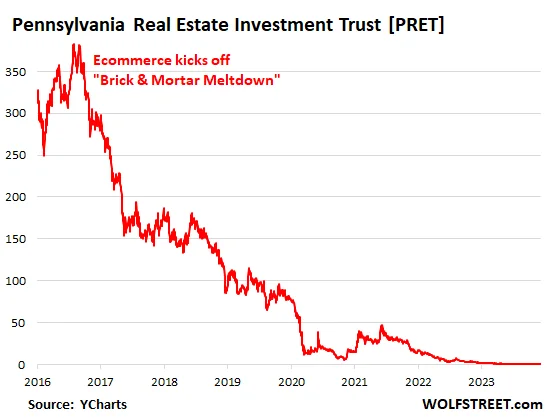
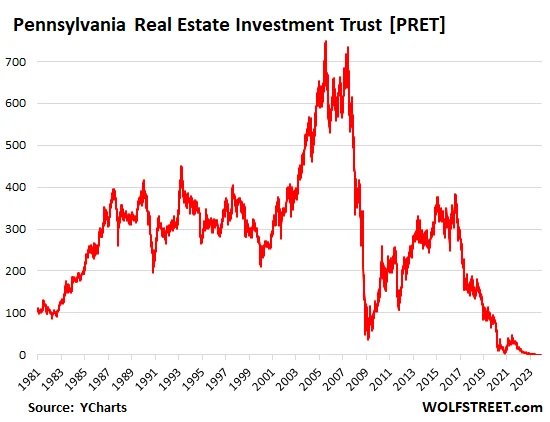
Pennsylvania Real Estate Investment Trust (PREIT), a publicly traded mall landlord, has announced it has filed for a pre-packaged Chapter 11 bankruptcy. This filing represents its second bankruptcy attempt following a previous pre-packaged bankruptcy in November 2020. As part of this latest restructuring deal, both existing preferred and common shares will be entirely canceled, effectively removing PREIT from the ranks of publicly traded companies. The restructuring sees a group of creditors, including Redwood Capital Management and Nut Tree Capital Management, taking control of the company.
Since being delisted from the NYSE in December 2022, PREIT's shares have traded over the counter. A reverse stock split in June 2022, where 15 existing shares were consolidated into one to boost the price above $1, provided only temporary relief. Following the latest announcement, PREIT’s share price surged by 81%, reaching $0.43. This spike occurred due to a provision in the restructuring deal, which allocates $10 million for preferred and common shareholders, though this fund is subject to costs associated with distribution. Common shareholders, in particular, will share a mere $3 million after expenses.
PREIT joins the list of mall real estate investment trusts (REITs) succumbing to financial pressures, following similar bankruptcies of the CBL & Associates Properties and Washington Prime Group since late 2020. This trend is indicative of a broader transformation in consumer behavior, heavily skewed towards ecommerce at the expense of traditional brick-and-mortar retail — a phenomenon that has been termed the "brick-and-mortar meltdown." This term highlights the ongoing struggle of physical retailers to adapt and survive within the shifting landscape.
Financial Context and Concerns
As of the end of Q3 2023, PREIT reported a staggering $1.8 billion in debt. The company has consistently faced losses over recent years, with a net loss of $168 million recorded across the first three quarters of 2023 alone. The pre-packaged bankruptcy, expected from the outset after the initial 2020 filing, was formalized when PREIT disclosed its restructuring endeavors earlier this year.
In its bankruptcy filing, PREIT outlined a Restructuring Support Agreement (RSA) that has garnered approval from 95% of its creditors. The RSA includes a $60 million Debtor-in-Possession (DIP) financing arrangement to facilitate ongoing operations during the bankruptcy proceedings, alongside a $75 million “exit financing” plan for when it emerges from bankruptcy. Both financing avenues stem from the investor group led by Redwood Capital and Nut Tree Capital, totaling $135 million.

While conducting its bankruptcy proceedings, PREIT has committed to ensuring the payment of vendors, suppliers, and employees, which is a common but critical aspect of maintaining operations and stakeholder trust during restructuring.
For first lien debt holders (primarily banks), the agreement permits a full cash paydown or a share of term loans equivalent to 101% of their claims. This signals an intent to maintain relationships with financial backers and underscores the emphasis on stabilizing its debt maturity schedule with an additional $150 million commitment of recapitalization from these banks.
Meanwhile, second lien debt holders will receive equity in the restructured entity, which includes the distressed debt funds that have acquired second lien debt at significantly discounted rates. As part of the plan, these stakeholders will hold a 65% equity share in the newly restructured PREIT once it exits bankruptcy, while those supporting exit funding will obtain the remaining 35% equity.

The ownership transfer marks a pivotal change in direction for PREIT, which is now in the hands of private equity firms and distressed debt managers tasked with navigating the challenges posed by the continuing decline of traditional retail spaces. This could potentially lead to reimagining the use of their mall properties, possibly transforming unused spaces into high-density housing or other adaptive reuse projects, as vacant storefronts and sprawling parking lots become increasingly commonplace.
Looking Ahead at the Retail Landscape
The broader implications of PREIT's bankruptcy resonate beyond just its immediate stakeholders. The pattern of mall closures reflects a significant shift in consumer preferences that has been exacerbated by the pandemic. Retail chains across the board, including giants like Sears, have struggled, leading to numerous bankruptcies, liquidations, and a growing stock of vacant malls. The fallout from these closures culminates in a reality where many malls are either left to deteriorate or are redeveloped for alternative uses.
The pathway forward for PREIT is fraught with uncertainty, contingent upon how effectively its new owners can pivot from traditional retail models towards innovative uses for its properties. As we monitor the situation, it’s essential to consider how consumer habits will continue to evolve and what this means for the future of retail real estate.
In conclusion, as the market adjusts to these shifts, observers will be keen to see how PREIT and similar entities navigate the complexities of a post-bankruptcy landscape and the broader retail environment.


