Side A · Liner notes
Commercial Real Estate Delinquencies Surge Amid Market Uncertainty
Banking · Words by Wolf Richter · Released
Delinquency rates for commercial real estate loans are rising, particularly in the office and retail sectors, as economic pressures challenge recovery efforts.
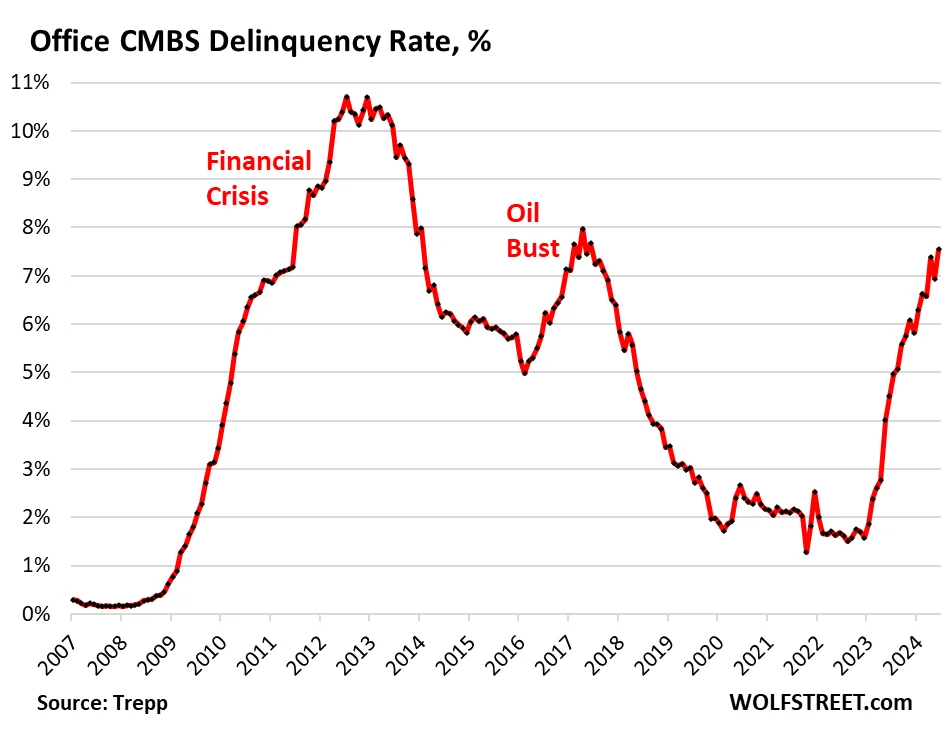
The commercial mortgage-backed securities (CMBS) sector continues to face significant challenges as delinquency rates rise for various property types, especially offices and retail. According to data from Trepp, delinquency rates among office CMBS loans have reached alarming levels, escalating to 7.6% in June. This marks the highest rate since the downturn of the Houston office market during the oil bust in 2016.
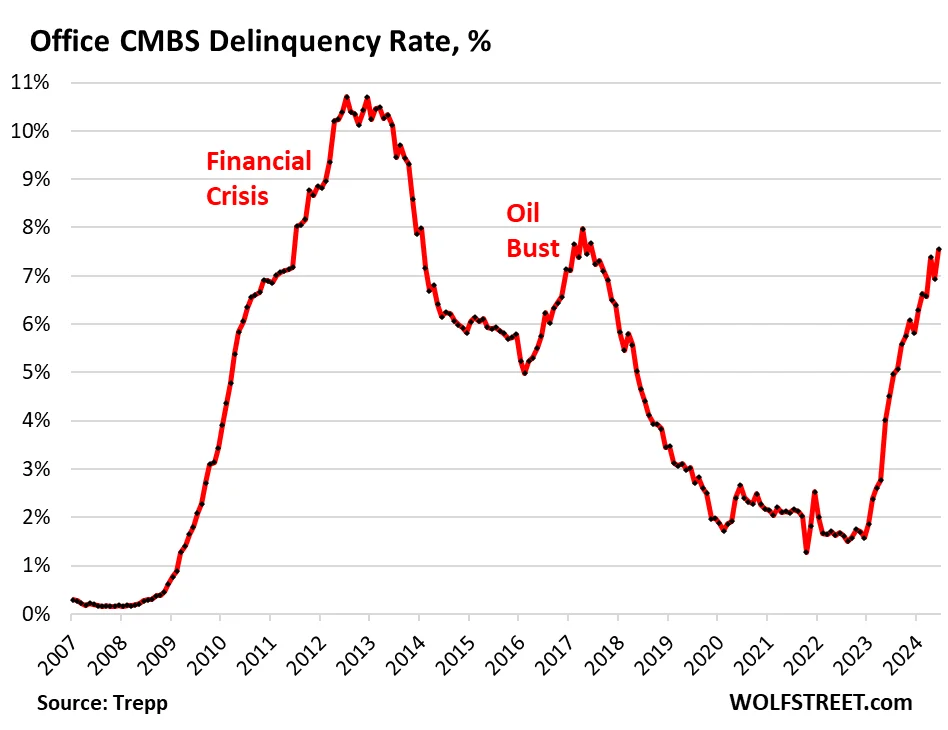
Office CMBS: A Rising Tide of Delinquencies
In June alone, approximately $1.87 billion in office loans became newly delinquent. However, a net effect of $1 billion in delinquency occurred after accounting for $900 million worth of loans that reverted to current status. The underlying issues driving this surge are primarily related to the structural decline in demand for office space, alongside the financial implications of floating-rate mortgages and an increase in loan maturities amidst rising interest rates.
Floating-rate office loans are experiencing particularly high delinquency rates, documented at 20%, while fixed-rate loans linger at 4.7%. The challenge arises when previously low-interest loans at around 3.5% require refinancing at rates of 7%, which may render many buildings economically unviable, particularly those with high vacancy rates. In such cases, rents frequently fall short of covering rising interest and associated expenses.
The Extend-and-Pretend Phenomenon
The current narrative among investors and lenders is one characterized by an "extend-and-pretend" mentality. CMBS lenders are reluctant to foreclose on properties, as doing so would result in substantial losses, especially for those holding low-rated tranches. Consequently, they and landlords are increasingly opting for loan restructuring and modifications rather than allowing delinquencies to escalate.
This dynamic is further complicated by the dramatic decline in property values. In several markets, the value of office properties has plummeted by 50% to 70%. This situation leaves both landlords and lenders in a precarious position, where the financial stakes compel both parties to reach agreements that might otherwise seem adverse.
Retail CMBS: Under Duress
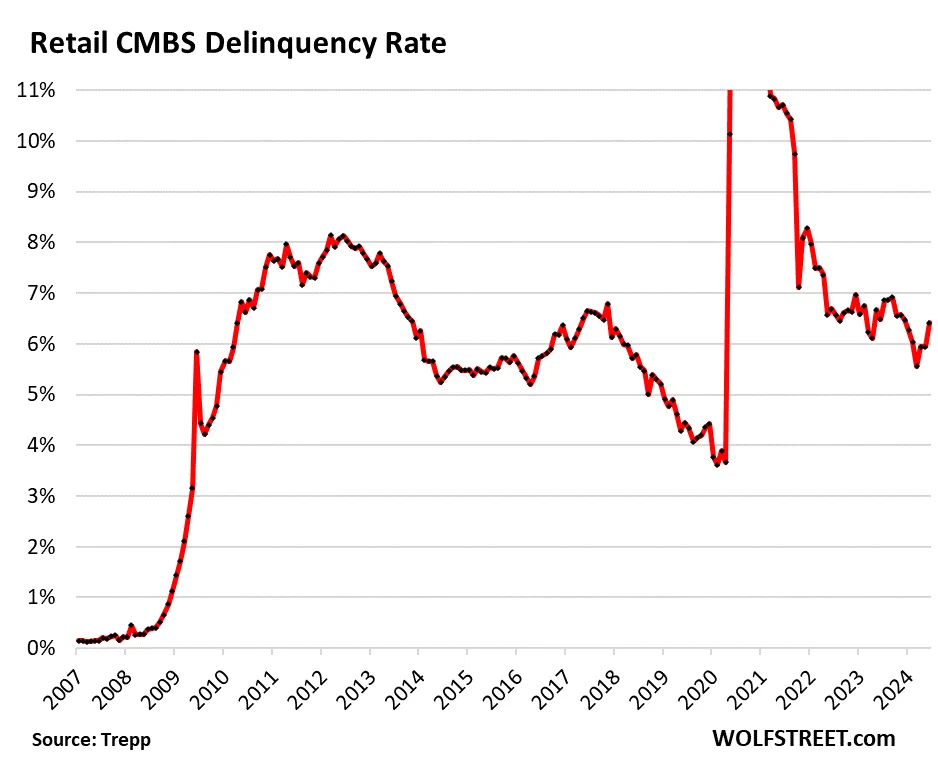
Retail properties are not faring much better, with delinquency rates for mall-backed CMBS rising to 6.4%. Retail has been grappling with such issues since the Great Recession, often referred to as the "Brick-and-Mortar Meltdown." A continuous stream of bankruptcies has plagued the sector, affecting iconic retail chains and forcing landlords like Simon Property Group to abandon properties even before the pandemic hit.

In June, retail CMBS delinquencies surged by a net amount of $525 million, driven by four mall loans each exceeding $100 million. The relentless shift toward e-commerce exacerbates the situation for brick-and-mortar stores. Traditional malls have struggled to adapt, while grocery-anchored strip malls have seen some resilience.

Lodging CMBS: Rising Challenges
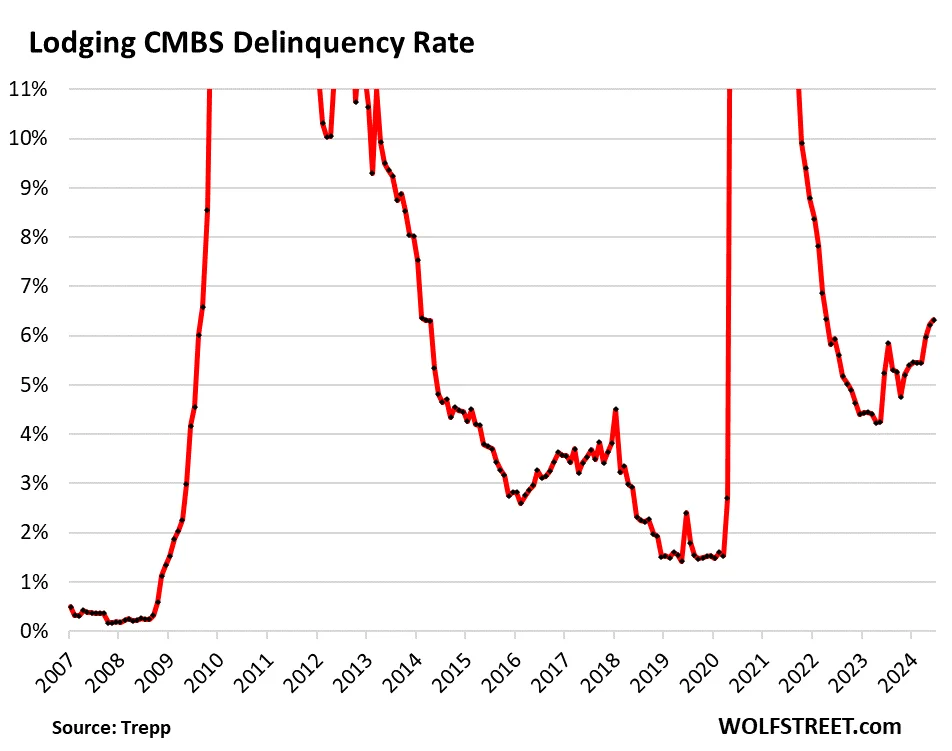
Similarly, the lodging sector is facing challenges with delinquency rates for hotel and resort properties increasing to 6.3% in June. The cumulative effect of lingering economic pressures and slow recovery in the travel sector contributes to these rising numbers.
Multifamily CMBS: Managing Delinquency Levels
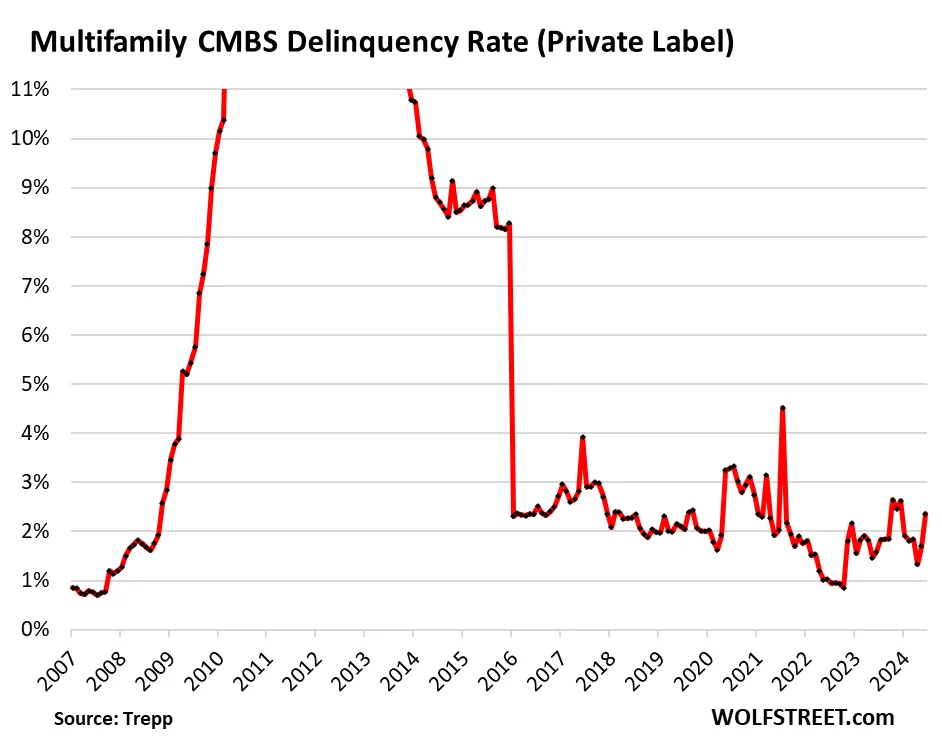
In contrast, multifamily properties have shown more resilience, with delinquency rates rising to 2.4%. Although there have been notable defaults in recent years, the overall delinquency rate remains manageable. Multifamily real estate is the largest sector of commercial real estate, encompassing about $2.1 trillion in loans globally, with government-backed loans accounting for roughly 55% of the total.
This relative stability exists despite some significant delinquency episodes. Notably, the resolution of a single $3 billion delinquencies, following the acquisition of Stuyvesant Town–Peter Cooper Village by Blackstone and Ivanhoe Cambridge, dramatically impacted the overall delinquency rates in January 2016.
Industrial CMBS: The Bright Spot
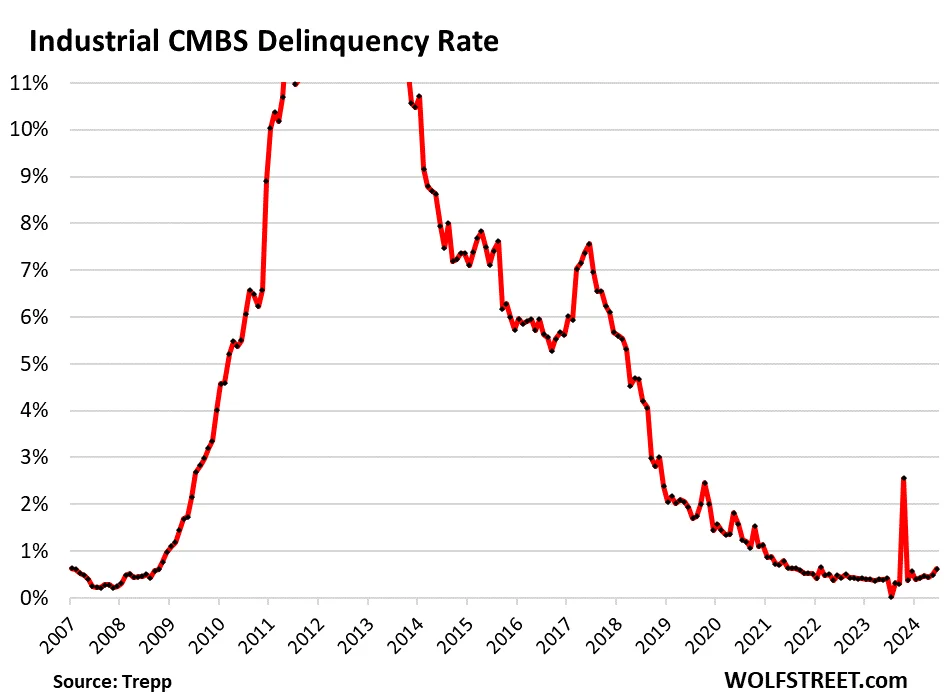
On a more positive note, industrial CMBS mortgages are experiencing only minor delinquencies, noted at 0.6%, a figure that remains historically low. The increasing demand for logistics infrastructure, propelled by e-commerce growth, continues to fuel this sector's stability.
As stakeholders navigate these turbulent waters of rising delinquency rates across various sectors, the overarching themes of economic pressures, shifting market dynamics, and evolving consumer behavior render the near-term outlook for commercial real estate quite uncertain. Investors, lenders, and tenants alike will need to remain vigilant as they assess the unfolding landscape.


