Side A · Liner notes
Analysis of Interest Rate Caps and Their Impact on Risky Borrowers' Credit Access
Banking · Words by Christopher Brown · Released
Research shows that interest rate caps in several U.S. states led to significant declines in loan balances for risky borrowers, without reducing delinquencies.

The introduction of interest rate caps across various U.S. states marks a significant shift in lending practices aimed at better protecting high-risk borrowers. However, recent findings indicate that these caps may result in unintended consequences, particularly affecting access to credit for the very group they intend to help.

The Historical Context of Interest Rate Caps
Interest rate caps have historically fluctuated in presence and enforcement across the United States. This resurgence is partly a reaction to the emergence of payday lending in the mid-1990s, aiming to address growing concerns regarding predatory lending practices. The first national usury limit was established in 2007, capping rates on loans to military personnel at 36 percent. This precedent paved the way for legislative proposals, such as the Predatory Loan Elimination Act, which seeks to extend similar caps nationwide.

A historical analysis reveals that earlier reforms from the early 20th century advocated for increased borrowing limits, with many states adjusting caps to between 36 and 42 percent. Nevertheless, the introduction of contemporary caps raises concerns about whether they can successfully balance lowering borrowing costs without stifling credit supply.
The Mechanics of Credit Rationing
Critics argue that imposing interest rate caps isn't merely about lowering costs but may inadvertently limit credit availability for riskier borrowers. In a standard credit model, different interest rates are applied to high-risk borrowers compared to their low-risk counterparts due to the anticipated default risk. When a cap is imposed, lenders may not find the incentive to issue loans at a lower rate that does not cover their operational costs, leading to credit rationing. Essentially, if lenders cannot recover their costs through sufficient profit margins, they may opt to entirely withdraw from lending to high-risk segments.
As a result, high-risk borrowers could face increased challenges, potentially having fewer avenues to access necessary credit. Given that these individuals also tend to require smaller loan amounts, they are particularly impacted by restrictive lending policies.
Research Findings on Loan Balances
Our study examined the impact of 36 percent interest rate caps implemented in Illinois, South Dakota, and North Dakota from 2016 to 2022, analyzing data from the New York Fed Consumer Credit Panel/Equifax. This dataset represents a substantial cross-section of over 35 million borrowers and provides insights into resultant credit trends.
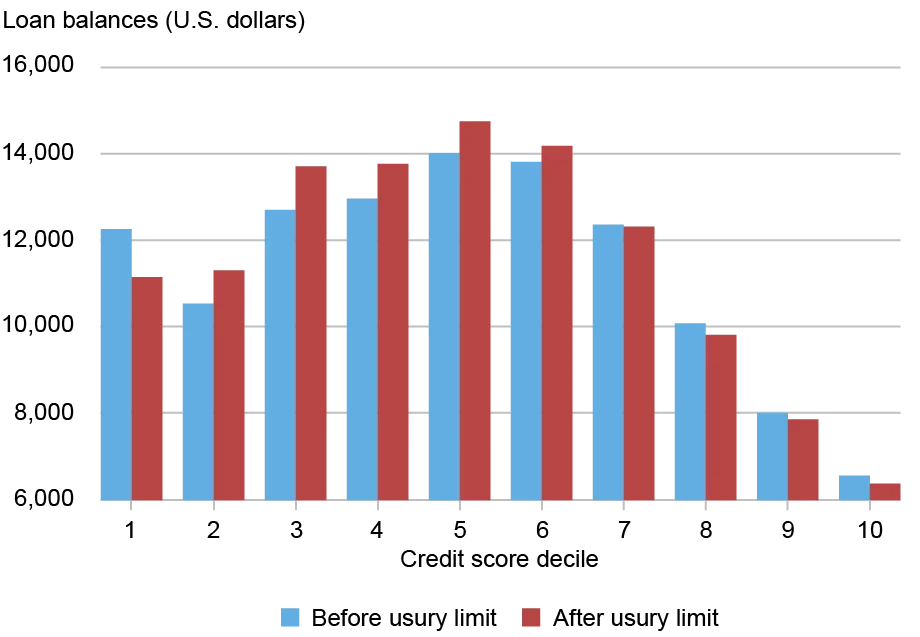
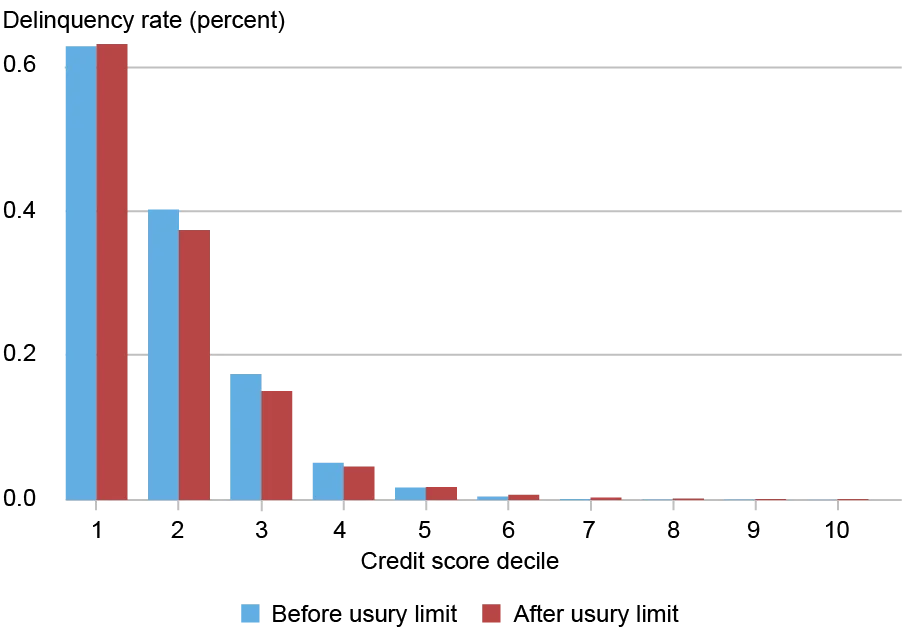
Data segmented by credit score deciles revealed that the average loan balances for the riskiest borrowers (the lowest credit score decile) declined significantly, dropping by approximately 8 percent post-cap. Conversely, balances for lower-risk borrowers remained relatively stable. Notably, while a reduction in debt levels might suggest that risky borrowers are avoiding potential "debt traps," the lack of corresponding improvement in delinquency rates raises further questions about the efficacy of such caps.
Delinquency Rates Post-Cap
Despite the decrease in credit balances, delinquencies among the riskiest borrowers did not show expected improvement; the share of accounts delinquent for over 90 days remained mostly unchanged in the months following the implementation of rate caps. In contrast, delinquency levels among moderately risky borrowers tended to decrease, suggesting that the financial reprieve might not be reaching those intended to benefit from these legislative changes.

Comparative Analysis Across States
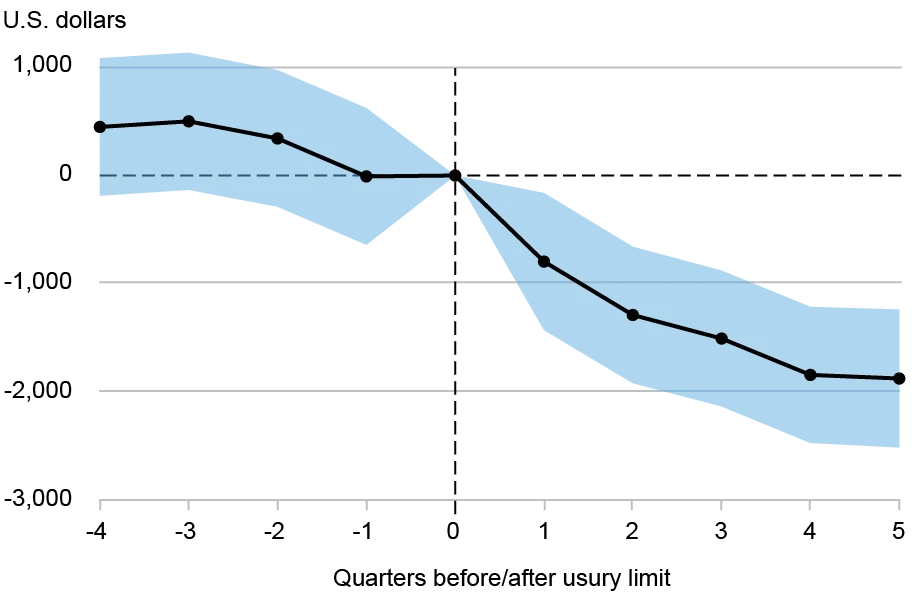
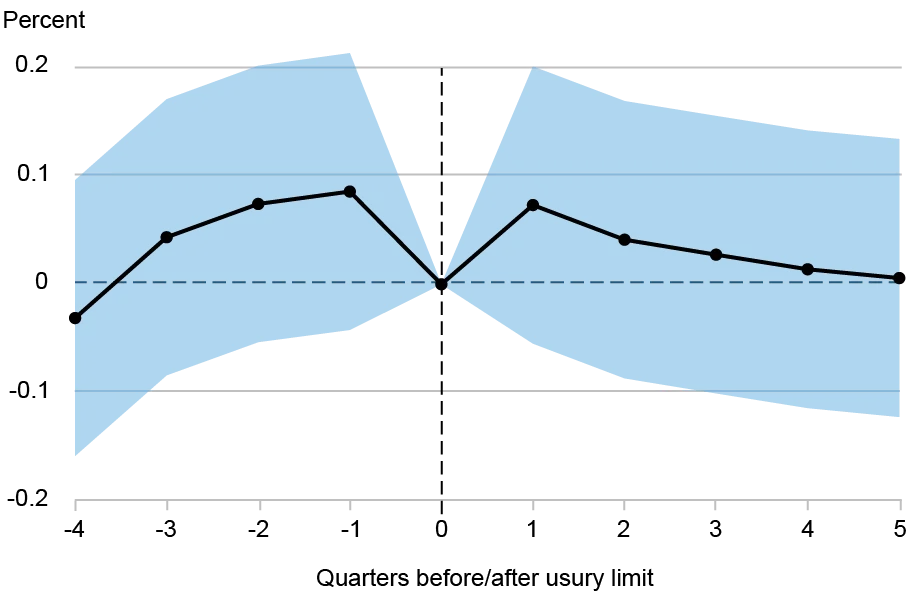
To evaluate the broader implications of interest rate caps, our analysis juxtaposed borrowers in states that enacted limits against those in neighboring states with no such regulations during the same period. Event-study regression models were employed to quantify changes in loan balances and delinquency rates.

The findings revealed that average loan balances for the riskiest borrowers in states with rate caps significantly decreased relative to control states. Specifically, average debt levels plummeted by around $2,000 five quarters after the caps were implemented, indicating a stark shift in borrowing capabilities.
However, the analysis of delinquency rates painted a more ambiguous picture. While some variation was observed, no significant decline in delinquent accounts emerged for high-risk cohorts within the states enforcing caps, further suggesting that reduced credit access does not correlate with improved repayment behaviors.
Conclusions and Implications
As interest rate caps resurge as a popular regulatory tool for protecting burgeoning populations of vulnerable borrowers, they illustrate the age-old balancing act between accessible credit and investor return. While proponents champion these caps as a means to enhance borrower negotiations and decrease overall debt burdens, the evidence suggests significant pitfalls in their implementation. The stark declines in loan balances yet unresponsive delinquency trends for high-risk borrowers undermine the presumed benefits of such caps.
Looking ahead, the anticipated follow-up study will delve into whether lenders redirect credit to less risky borrowers in the context of rate caps. Understanding these dynamics will further shape expectations around regulatory interventions designed to safeguard consumers within the lending landscape.

Rajashri Chakrabarti is an economic research advisor in the Federal Reserve Bank of New York’s Research and Statistics Group.

Gabriel Leonard is a research analyst in the Federal Reserve Bank of New York’s Research and Statistics Group.

At the time this post was written, Donald P. Morgan was a financial research advisor in the Federal Reserve Bank of New York’s Research and Statistics Group. He is now retired.

Thu Pham is a research analyst in the Federal Reserve Bank of New York’s Research and Statistics Group.

Lee Seltzer is a financial research economist in the Federal Reserve Bank of New York’s Research and Statistics Group.


