Side A · Liner notes
Declining Renter Mobility: Understanding the Shift in Homeownership Expectations
Banking · Words by Joseph Brown · Released
A significant decline in renter mobility and expectations of homeownership signals broader challenges in the housing market and mortgage affordability.

Recent trends indicate that Americans are moving significantly less than in the past. Moving rates, which have seen a gradual decline from nearly 20 percent in the mid-1980s to below 10 percent by 2019, highlight a shift in behavior that has persisted across various business cycles and demographic groups. This reduction in mobility is critical; relocating can be essential for accessing better job opportunities, adjusting to life changes, and securing improved housing conditions.

Focusing on renters, who make up about a third of U.S. households, insights gleaned from the annual New York Fed SCE Housing Survey reveal a pronounced drop in anticipated mobility. Expected mobility among renters is important, as they are not bound by the mortgage rate lock-in that homeowners face. Typically, decreases in expected mobility can serve as an early indicator of future moving behaviors.
Renters’ Declining Mobility Expectations
Data over the past 12 years demonstrate a steep decline in the likelihood of renters moving within the next three years. The mean probability of moving for renters dropped from approximately 57 percent in 2014 to around 37 percent in 2026. During the same timeframe, the anticipated movement probability for homeowners decreased from about 21 percent to 14 percent. It’s notable that renters experienced a more significant decline in expected mobility compared to homeowners.

Perceptions of Homeownership
Renting often intertwines with aspirations of homeownership. The SCE Survey assesses renters' perceptions of future ownership, revealing a drop from roughly 52 percent likelihood of eventual homeownership in 2015 to about 35 percent by 2025. This sharp decline, particularly pronounced from 2021 onward, raises questions about the factors influencing these perceptions. Renters who anticipate low chances of ever owning a home (0-20 percent) correspondingly exhibit a mean three-year moving probability of only around 25 percent. In contrast, those who are confident in their prospective homeownership (81-100 percent) report a mean moving probability of about 76 percent—indicating a disparity exceeding 50 percentage points based on these outlooks.

Factors Influencing Renters’ Expectations
The decline in renters’ expectations regarding homeownership can largely be attributed to two major factors: the perception of increasing unaffordability of homes and a potential shift in attitudes towards ownership. First, many renters now view homeownership as out of reach due to rising mortgage rates, property prices, and the costs associated with buying a home. The SCE data indicate that perceptions of mortgage access are significantly affecting renters' plans to move.

Perceived Mortgage Accessibility
The Survey of Consumer Expectations detailed a stark transition in renters' perceptions of mortgage accessibility. In 2021, approximately 27 percent of renters believed that obtaining a mortgage would be challenging. This figure surged past 45 percent by 2024. Concurrently, the median expected mortgage rate for prospective applicants jumped from around 3.3 percent in 2021 to nearly 6.8 percent in 2024—an increase of over 100 percent in just three years. Such perceptions strongly correlate with anticipated mobility; renters who anticipate lower rates and easier access to mortgages report higher probabilities of moving.

Impact of Mortgage Expectations on Mobility
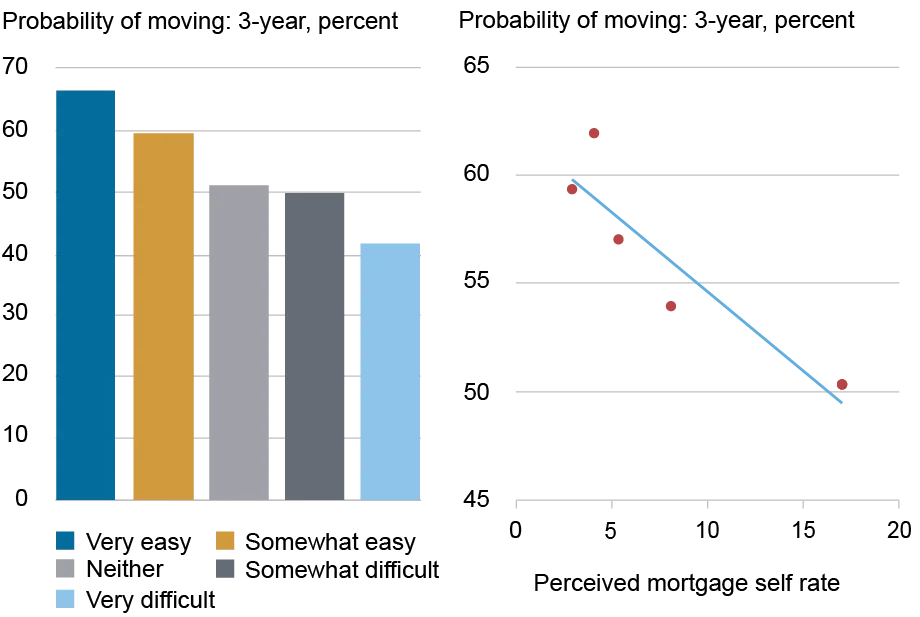
Analysis shows that renters perceiving high mortgage difficulty are less prone to plan moves. For example, renters stating that obtaining a mortgage would be very easy report a mean three-year moving probability of about 66 percent, in stark contrast to only 42 percent among those who believe it would be very difficult. Similarly, those expecting rates around 3 percent have a mean moving probability of about 60 percent, dropping to about 54 percent for those anticipating rates near 8 percent. This suggests that perceptions of mortgage affordability wield significant influence over renters' mobility predictions.

Desire for Home Ownership
While affordability challenges loom large, it's also necessary to consider shifts in renters' desires for homeownership. The SCE Survey further explores whether renters would still prefer to own a home given adequate financial resources. This hypothetical scenario helps disentangle economic constraints from personal preferences. Responses indicate that since 2015, about 65-74 percent of renters consistently express a strong preference for owning a home if financially feasible. Meanwhile, perceptions of homeownership as a sound investment hover consistently between 51 and 68 percent over the same period.
Conclusion: Understanding the Trend
Emerging patterns signal a worrying trend: as renters become increasingly convinced that homeownership is out of reach, they concurrently express less likelihood to move. This dual observation highlights a significant issue—rising perceptions of mortgage inaccessibility contribute heavily to declining mobility among renters. Consequently, tackling housing affordability remains vital not just for individual aspirations, but also for bolstering overall residential mobility in the United States.
In sum, while many renters continue to desire homeownership, their changing perceptions surrounding its feasibility play a critical role in their expectations of future moving behavior. Understanding and addressing these dynamics could illuminate pathways for improving both housing access and mobility across the broader market.


