Side A · Liner notes
Labor Market Tightness: Insights from the Updated HPW Index and Wage Inflation Forecasting
Banking · Words by Thomas Davis · Released
The HPW Index shows promising accuracy in forecasting wage inflation, reflecting current labor market conditions and introducing monthly updates.

Understanding labor market dynamics is essential for predicting wage inflation, which plays a crucial role in shaping monetary policy. The recently updated Heise, Pearce, Weber (HPW) Index emerges as a significant tool for this purpose, offering insights into labor market tightness. An earlier analysis published in October 2024 established this index as the most reliable of various measures for tracking wage growth. This report further extends that analysis, revealing that the HPW Index not only reflects current labor conditions but also serves as an effective predictor of future wage inflation.

HPW Index Performance through 2025
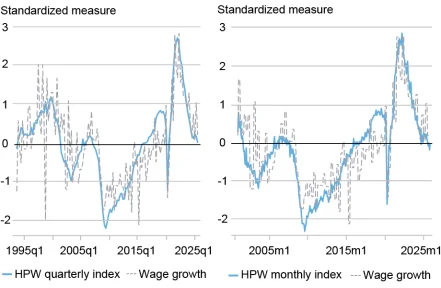
The HPW Index has undergone updates through the third quarter of 2025 and into November 2025, reflecting the evolving landscape of the labor market. Traditional metrics like the unemployment rate and the vacancy-to-unemployment ratio have shown inconsistent results in tracking wage growth. For instance, while the unemployment rate quickly rebounded to pre-pandemic levels after a spike in early 2020, wage growth remained elevated throughout 2022. The HPW Index incorporates a more holistic view by factoring in the behaviors of employed job seekers, highlighting the significance of on-the-job search as a key determinant of labor market tightness.

Two critical indicators have been identified for their effectiveness in tracking wage growth: the quits rate and vacancies per effective searcher (V/ES). The quits rate is derived from the Job Openings and Labor Turnover Survey (JOLTS), while V/ES combines data from both JOLTS and the Current Population Survey (CPS). The HPW Index synthesizes these metrics, applying regression-derived coefficients to weight them accordingly. In the most recent update, the HPW Index indicates a reading of -0.01 in November 2025, suggesting that wage pressures are aligning closely with long-term averages.

Forecasting Wage Inflation
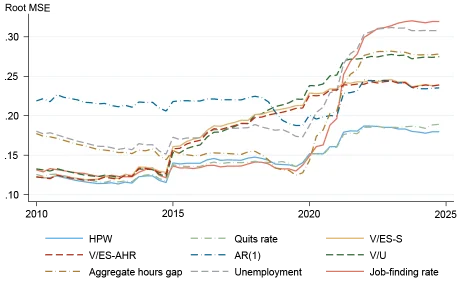
The HPW Index's forecasting capabilities are particularly robust when evaluated against various labor tightness measures. It outperformed other models, including those relying solely on historical wage growth data, confirming its effectiveness in predicting wage inflation. By using quarterly data to model predictions, a comparison indicates that both the HPW Index and the quits rate provide the most accurate out-of-sample forecasts of the three-month ECI wage growth.

The forecasting model initiates with data from 2004:Q1, rolling predictions forward through subsequent quarters. The evaluation metric, root mean square error (root MSE), illustrates how accurately each measure predicts actual wage growth based on available data. A trend analysis suggests that prior to the COVID-19 pandemic, both the HPW Index and quits rate were leading indicators. Post-2020, they distinguished themselves as the top predictors of wage growth, while traditional measures like the V/U ratio began to falter in reliability.
Current Labor Market Dynamics
The findings reported by the HPW Index demonstrate that wage growth is at a plateau after a downward trend from 2022 through 2024, indicating a potentially stable labor market moving forward. As the HPW Index continues to provide both quarterly and monthly updates via the New York Fed's website, practitioners can rely on this tool for real-time insights into labor market tightness and wage pressures.

Two measures are consistently highlighted as the strongest predictors of wage growth: the HPW Index itself and the quits rate. Their predictive power is vital for policymakers who need to navigate the complexities of monetary policy in response to evolving labor conditions. The HPW Index thus not only tracks current market conditions but also equips stakeholders with a forecasting tool that holds a promising record for accuracy.

Conclusion: Implications for Policymakers
The insights gained from the HPW Index emphasize the importance of refining measurement techniques in the assessment of labor market tightness. By offering a regular update on both quarterly and monthly scales, it assists in shedding light on wage growth trends, enabling policymakers to make informed decisions. This web feature provides a timely lens through which to view labor market dynamics and its implications for wage inflation. As more data becomes available, the HPW Index will remain a vital resource for understanding labor market conditions.
Moving forward, it will be pertinent for economists, policymakers, and finance professionals to monitor the performance of the HPW Index, as its accuracy in forecasting wage inflation could influence key economic decisions.


