Side A · Liner notes
Understanding the Underlying Causes of Bank Failures: Insolvency Versus Liquidity
Banking · Words by Sergio Correia, Stephan Luck, and Emil Verner · Released
Research emphasizes that bank failures predominantly arise from insolvency issues rather than liquidity crises, with significant implications for financial stability policy.

Sergio Correia, Stephan Luck, and Emil Verner's insights delve into the persistent question of what primarily drives bank failures: runs on deposits or insolvency. Their research highlights a critical distinction, suggesting that while liquidity crises can accelerate failures, it is typically the underlying solvency problems that are to blame.

Why Bank Failures Matter
Bank failures present considerable ramifications for the economy, often leading to substantial real costs and systemic disruptions. The United States has faced repeated waves of bank failures throughout its history, prompting an ongoing debate about the causes. Are these failures due to depositors panicking, or do they result from deeper solvency issues that may precipitate such runs?
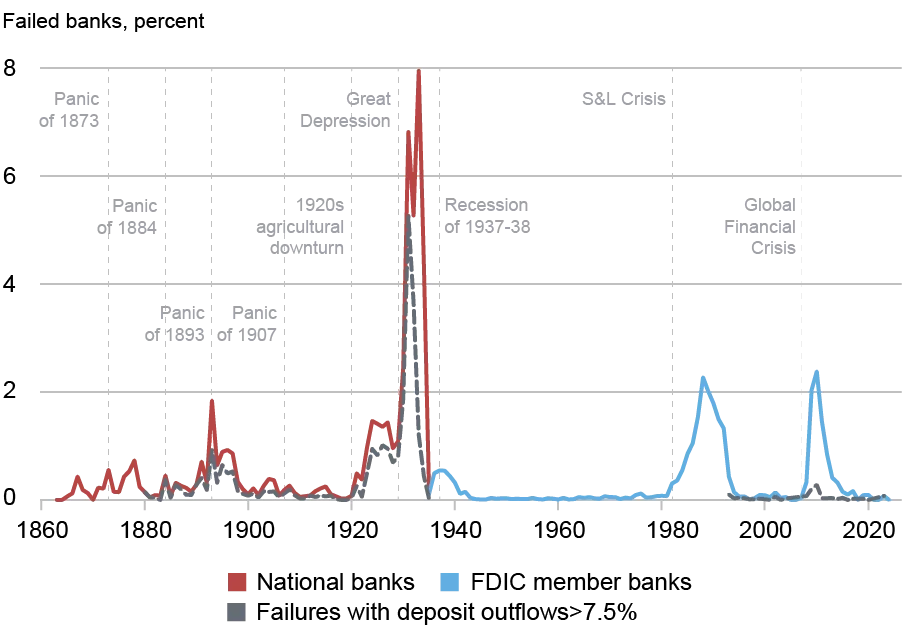
The answers to these questions significantly impact financial policy decisions. If bank runs are the primary concern, enhancing deposit insurance and central bank lending would be effective measures to counteract failures. The aftermath of the March 2023 collapse of Silicon Valley Bank raised calls for improvements in lender-of-last-resort policies and expanded deposit insurance as essential protective measures.

However, if the root cause of failures is indeed fundamental insolvency, focus must shift to enhancing bank capital, risk management, and supervisory oversight.

Bank Failures: Theoretical Framework
Two central theories address the origins of bank failures: the liquidity view and the solvency view. The liquidity perspective suggests that sudden, mass withdrawals can force banks into a position of having to liquidate assets at significantly reduced prices, which can turn viable banks into insolvent ones. This indicates that runs can indeed precipitate failures.

Conversely, the solvency view posits that banks become fundamentally insolvent when their assets lose sufficient value to cover depositor liabilities. Essentially, a bank's insolvency creates conditions ripe for a run, and while the run may trigger closure, it is not the initiating problem.

Empirical Evidence on Bank Failures
Research findings emphasize the consistent link between bank failures and underlying weaknesses in bank fundamentals:

- Finding 1: Weak fundamentals are central to bank failures. Analysis shows that banks that failed during the Great Depression disproportionately exhibited poor capitalization, illiquid assets, and vulnerability to local economic downturns. The correlation between declining income, growing asset losses, and reliance on expensive funding has persisted over time, demonstrating that failing banks are often predictable based on these deteriorating fundamentals.
- Finding 2: Recovery rates illuminate bank failures’ root causes. An assessment of recovery rates on assets from failed banks prior to the establishment of federal deposit insurance in 1934 reveals that creditors generally reclaimed only about 75 cents on the dollar, while unsecured depositors recovered about 66 cents. This indicates that most failed banks were fundamentally insolvent, suggesting that runs on solvent banks contributed minimally to national bank failures.
- Finding 3: Bank examiners rarely attribute failures to runs. Historical data from bank examiners indicates that most failed banks struggled with diminished asset quality, with only 36% of their assets classified as “good.” Instead, examiners identified fundamental issues such as poor economic conditions and asset losses as the primary failure causes, with runs cited far less frequently.
- Finding 4: Strong banks can endure runs thanks to various protective mechanisms. While runs are common at struggling institutions, stronger banks that face similar situations often employ strategies like issuing loans to signal security, interbank lending for liquidity support, or suspending convertibility to reassess their financial standing. These defenses help prevent solvent banks from succumbing to panic-induced failures.
Policy Implications of Bank Failure Causes
The predominance of solvency issues driving bank failures carries significant implications for financial stability strategies. Although the introduction of federal deposit insurance has considerably reduced failures attributed to runs, it hasn’t entirely eliminated waves of bank closures. In many instances, failures now occur more frequently due to supervisory actions rather than depositor behaviors.
This shift highlights a need for enhanced vigilance among supervisors to identify potential insolvencies early and act to mitigate associated losses. Further, lender-of-last-resort policies that provide liquidity can support solvent banks amid panic, as demonstrated by historical comparisons of varying Federal Reserve approaches during the Great Depression.
However, as international evidence suggests, an emphasis on liquidity without addressing underlying insolvency problems can lead to severe credit market contractions. Past liquidity interventions have also proven insufficient for fixing distressed banks, which necessitated balance sheet restructuring.
Conclusion
In summary, the historical analysis of bank failures underscores a consistent theme: failures usually stem from deteriorating solvency linked to poor asset quality and inadequate capitalization. While runs can indeed exacerbate the situation, they often serve as a symptom, rather than the root cause, of deeper financial issues. Ensuring banks are well-capitalized and managing risk prudently emerges as the strongest strategy for mitigating the risk of future failures.
As this ongoing dialogue evolves, the systemic risks posed by insolvency underline the importance of rigorous supervision and proper capital structures within the banking sector. Avoiding excessive lending booms and ensuring adequate financial buffers will be critical to maintaining stability in the banking system.


