Side A · Liner notes
Remote Work's Impact on Youth Unemployment: The Case of Young College Graduates
Banking · Words by Christopher Martinez · Released
Remote work significantly contributes to youth unemployment, particularly among young college graduates, as firms struggle to mentor new hires effectively.

Research by Natalia Emanuel, Emma Harrington, and Amanda Pallais highlights a troubling correlation between the rise in remote work and youth unemployment, specifically among young college graduates. The data indicates that remote work accounts for approximately 64 percent of the increase in unemployment rates for this demographic from 2017 to 2024. Between 2017 and 2019, the unemployment rate for individuals under 29 averaged 3.1 percent, but this figure escalated to 3.7 percent during 2022 to 2025. This situation starkly contrasts with the experience of older college graduates, whose unemployment rate edged down from 1.9 percent to 1.8 percent in the same period.

Unemployment Trends Among Young College Graduates
The uptick in unemployment for young graduates is alarming, especially as early-career experiences can shape future prospects. Studies indicate that entering the job market during economic downturns can result in slower career advancement and reduced earnings compared to those who start during prosperous times. The authors cite this concern as especially relevant given that the recent rise in unemployment started aligning with the increased prevalence of remote work, rather than other factors like generative AI.
Exploring the Remote Work Connection
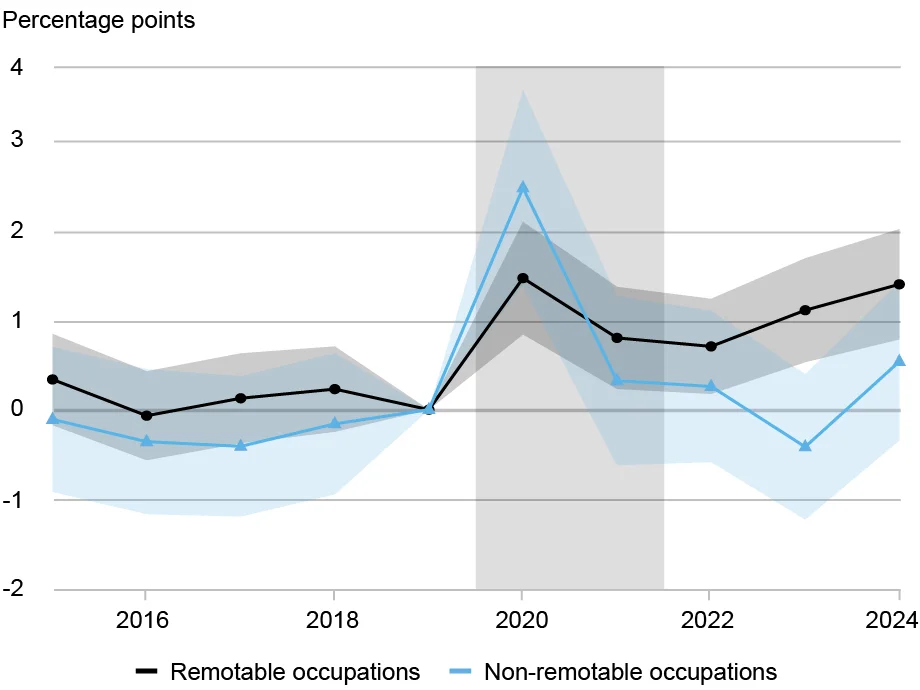
The analysis reveals a four-fold increase in remote work opportunities since the pandemic. Employers have shown hesitancy to onboard less-experienced workers into distributed teams, as the training and mentorship necessary for skill development are significantly compromised in remote settings. The researchers assess unemployment differences based on job market characteristics, classifying jobs as either “remotable” (like software engineering) or “non-remotable” (like mechanical engineering). The data illustrates a marked increase in unemployment for younger workers in remotable roles, suggesting remote work heavily influences hiring practices.

Specifically, the unemployment rate for younger individuals in remotable roles surged by nearly 1 percentage point from 2017-2019 to 2022-2024, while older workers in these sectors experienced a slight decline. This expanding age gap highlights the challenges young graduates face in securing meaningful employment in remote environments.

Contrasting Remote and Non-Remotable Job Markets
In non-remotable job types, young graduates witnessed a slight dip in unemployment during the early pandemic years, but overall conditions remained stable compared to the significant disturbances in remotable positions. This divergence further underscores the trend where fresh graduates are disproportionately affected by shifts toward remote work arrangements.

Debunking the AI Narrative
While some analysts attribute the rising unemployment rates among young graduates to the rise of generative AI, this analysis shows that the increase predates AI diffusion. Even when the impact of AI exposure is measured, the disparities in employment opportunities between younger and older workers persist. It suggests that although AI may play a critical role in shaping future employment trends, the rise of remote work is predominantly responsible for the current youth unemployment crisis.

Firm-Level Insights and Dynamic Feedback Loops
An examination of proprietary data from a Fortune 500 company illustrates how physical proximity to colleagues fosters mentorship and feedback essential for the development of less experienced employees. The study found that remote work diminishes the quantity of feedback new hires receive, which impacts their performance. This lack of interaction tends to be more detrimental to younger workers who rely heavily on constructive feedback for growth.
The quality of work also suffers when employees operate remotely, as those who had previously benefited from in-person mentorship outperformed their peers working in isolation. The firm’s shift in hiring practices reveals a strategic approach to mitigate risks associated with distant work; during the pandemic, hiring leaned more towards experienced individuals capable of functioning independently, while post-pandemic, younger employees were re-engaged for on-site roles.
Returns to Office Mandates and Youth Employment Opportunities
The firm's stricter return-to-office (RTO) policy stands in sharp contrast to the flexible approaches taken by other tech firms. This policy was designed to facilitate mentorship opportunities and effectively address the developmental needs of younger workers. Despite reopening, the firm continued to favor experienced candidates for remote positions, indicating an operational preference influenced by the challenges of training and oversight in remote environments. This serves as a warning sign that remote work may perpetuate barriers to entry for young job seekers.
Conclusion: A Call for Attention to Youth Employment
The evidence presented suggests that the shift toward remote work has detrimental effects on hiring younger workers by undermining essential on-the-job training and mentorship opportunities. This trend not only risks sidelining a significant segment of the workforce but also threatens the long-term career prospects of those who might struggle to enter the labor market during challenging times. The findings urge a reevaluation of remote work practices to ensure that the skills and mentorship necessary for young employees' success are adequately supported in the evolving job landscape.
The findings and data offer a clear directive for companies to rethink their strategies, particularly in how they handle onboarding and training for less experienced workers, especially when working remotely. Otherwise, as jobs become scarcer, young workers could find themselves stuck in a cycle of unemployment without the necessary skills to advance in their careers.


